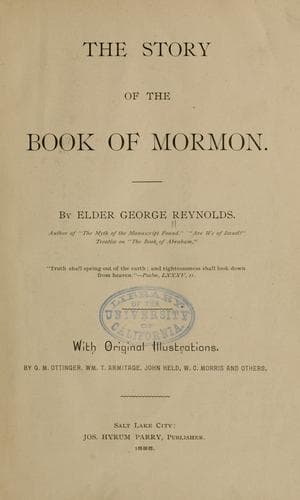
Book of Mormon; Latter Day Saint churches -- Doctrines; Latter Day Saints
The two sets of plates manufactured by Nephi were both used as records
of his people and called by his name; but their contents were not
identical. Upon the first set was engraven the political history of
the Nephites, upon the second their religious growth and development.
The one described the acts of their kings, and the wars, contentions
and destructions which came upon the nation; the other contained the
story of the dealings of the Lord with that people, the ministry of his
servants, the teachings and prophecies. Of the contents of the first we
know but little, simply that which we gather from incidental remarks
made in the second; but the second is given to us in its completeness
in the translation contained in the Book of Mormon.
It would have been very interesting to students of history to have
received the detailed account of the reigns of the kings who governed
the people of Nephi, that is, to those who would accept these records
as of God; but it was far more important that those most sacred truths
contained in the revelations of heaven to that people should be made
manifest to this generation. The one would be a satisfaction to our
intellectual natures, but the other is necessary to our eternal
salvation; for the Book of Mormon contains the fullness of the gospel,
and also many things plain and most precious that have been taken out
of the Jewish scriptures, through the craft or ignorance of apostate
Jews and Christians. For this most important reason those portions of
the Nephite records that are now contained in the Book of Mormon were
first revealed; we should never have been willing to have accepted
the others without them, for it is upon the basis of religion, not of
history, that the Latter-day Saints accept the Book of Mormon. We also
have the promise that other plates will be translated and given unto
us in the Lord's due time, and doubtless among them will be those first
plates upon which Nephi recorded, with such detail, the travels and
labors in the wilderness of his father and associates.
The plates of Nephi containing the sacred annals of his people were not
entirely filled with engravings until about two hundred years before
Christ. They were made by Nephi between the years 570 and 560 before
the advent of the Redeemer; but the record on them goes back to the
time when Lehi left Jerusalem, or 600 B. C., so they in reality contain
the history of God's dealings with that branch of the house of Israel
for about four hundred years.
Public-domain text, read in full here on John Shaqi.
Reviews
Reviews
No reviews yet
Be the first to share your thoughts on this work.
Elsewhere in the archive
Join the Discussion
Join the discussion
Sign in to leave a comment or review.
Sign InorCreate an account