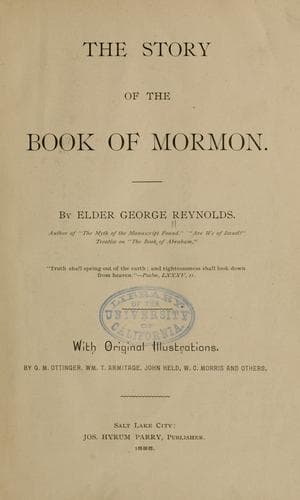
Book of Mormon; Latter Day Saint churches -- Doctrines; Latter Day Saints
From the casual references found in the historic portions of the Book
of Mormon, we are led to infer that the domestic life of the Nephites
was patterned, as it very naturally would be, after the manners and
customs of their forefathers in the land of Jerusalem, modified,
of course, by time and their surroundings. The changed material
conditions, the absence of older though co-existent peoples and powers,
the new and sometimes strange animal and vegetable productions, etc.,
all had an influence in the formation and growth of their civilization;
trivial, perhaps, when considered separately, but when taken together,
and working for centuries, having a marked effect on their public
polity and home life. It is, however, necessary to explain that the
details of the latter are very meagre, and only obtained incidentally,
as they may form a link in the chain of some historical narrative,
or be introduced as an illustration in some doctrinal teaching or
prophetic warning.
In the midst of a people guided or reproved through their entire
national life by an almost continuous succession of inspired teachers,
it is but reasonable to conclude that the domestic virtues were
assiduously cultivated, and all departures therefrom severely rebuked.
Industry, economy, thrift, prudence, and moderation in dress were
evidently as much the subject of the prophet's commendation then as
in these latter days. Zeniff and others directly refer to the labors
and toils of the Nephite women in spinning and making the material
with which they clothed themselves and their households; and the same
fabrics which delight the modern daughters of Israel also appear to
have pleased the eyes of their Nephite sisters in the long ago. We
must, however, say to the praise of these ancient worthies, the mothers
of Mosiah, Alma, Moroni, Helaman, and of the two thousand striplings
who loved to call the latter father, that the beauty of their apparel
was the workmanship of their own hands. Steam looms, spinning
jennys, and their like, were unknown, so far as we can learn, to the
enterprising, vigorous, God-blessed race that for nearly a thousand
years filled the American continent with the favored seed of Jacob's
much-loved son.
The materials of which the clothing of this race were made are
frequently mentioned in the inspired record. Fine silk, fine twined
or twisted linen, and cloth of every kind are often spoken of. In one
place good homely cloth is mentioned. By the word homely we must not
understand the writer to mean ugly; the word is there evidently applied
in its original significance, as it is used today in England, for
homelike or fit for home--such material as was suited to the every-day
life of an industrious, hard-working people.
Public-domain text, read in full here on John Shaqi.
Reviews
Reviews
No reviews yet
Be the first to share your thoughts on this work.
Elsewhere in the archive
Join the Discussion
Join the discussion
Sign in to leave a comment or review.
Sign InorCreate an account