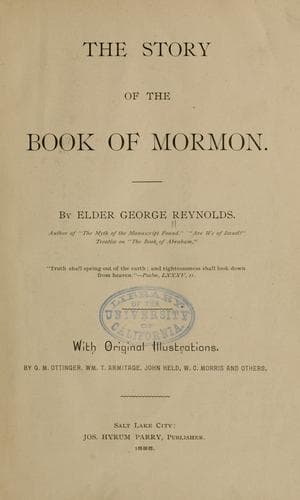
Book of Mormon; Latter Day Saint churches -- Doctrines; Latter Day Saints
CHAPTER LVI.
SCIENCE AND LITERATURE AMONG THE NEPHITES--THEIR ASTRONOMY AND
GEOGRAPHY--THE LEARNING OF EGYPT.
The Nephites were unusually happy in having, as the founders of their
nation, men who were not only wise in the ways of the Lord, but also
learned in the knowledge of the world. Most races that have made a mark
in history have had to grope their way for centuries from darkness to
light, from ignorance to knowledge. Little by little such races have
advanced in the path of civilization, falling into manifold errors, and
committing grievous blunders. With Lehi and his posterity it was not
so. They were taken from the midst of a people who were surrounded by
the most powerful and refined nations of antiquity, with whose wisdom
and learning Lehi was undoubtedly well acquainted. We can readily
conceive that the Lord, in planting this mighty and vigorous offshoot
of the house of Joseph, on the richest and most favored land of all
the earth, would not only choose one of his most faithful, but also
one of his most intelligent servants, to commence the work. Indeed, on
the very first page of the Book of Mormon, Nephi incidentally refers
to the learning of his father; which learning, we infer from many
passages in the sacred record, was obtained by Lehi in Egypt, as well
as in Palestine; the association between the inhabitants of these two
countries being, in his day, very close, and the inter-communication
frequent.
As the foundation of their literature, Lehi and his colony carried
with them a copy of the sacred scriptures, which contained not only an
account of God's dealings with mankind, from the creation to the age of
Jeremiah, but also the only complete history in existence of the people
who lived before the deluge. The Egyptians, Chaldeans and other nations
had mangled, mythic and jumbled-up accounts of man's history from the
creation to the flood; but the Nephites possessed the details of this
epoch in much greater completeness than even Christendom does today.
These scriptures--historical and doctrinal--being numerously reproduced
and scattered among the people, formed the basis of Nephite literature,
giving them the immense advantage over all other people of possessing
the unpolluted word of God in every age then past, supplemented by
a correct and undisputed history of the results, to the world, of
man's obedience or disobedience to these heavenly messages. How much
more complete these scriptures were than the Bible of Christendom is
shown by the numerous references to the lives, and quotations from the
teachings, of ancient worthies, Melchisedek, Jacob, Joseph and others;
to the acts and infamies of Cain, etc., not found in the Bible, as well
as by lengthy quotations from ancient prophets, whose names--Zenos,
Zenoch, Neum, Ezias--are not even mentioned in its pages. How much
modern Christianity has lost by these omissions may be partially
Public-domain text, read in full here on John Shaqi.
Reviews
Reviews
No reviews yet
Be the first to share your thoughts on this work.
Elsewhere in the archive
Join the Discussion
Join the discussion
Sign in to leave a comment or review.
Sign InorCreate an account