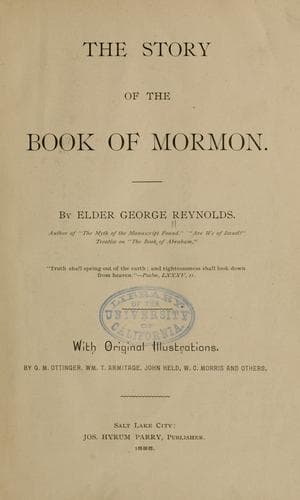
Book of Mormon; Latter Day Saint churches -- Doctrines; Latter Day Saints
Some of the readers of the Book of Mormon have imagined this line of
defense to have been one continuous rampart or wall--after the style
of the great wall of China--reaching from ocean to ocean, and on this
surmise have argued that the completion of such an immense work in a
few years was an impossibility to a people of the limited numerical
strength of the Nephites. To get over this difficulty of their own
creation they have resorted to various theories with regard to its
locality, inconsistent with the geographical details, on purpose to
shorten its distance to what they deemed a reasonable length, possible
for the Nephites to have built in a few years. The writer holds the
opinion that the Book of Mormon conveys no such idea, it simply states
that Moroni erected fortifications along this line; or, as he views
it, Moroni took advantage of the natural features of the country, its
wide rivers, far-stretching swamps and ranges of high mountains, and
built fortifications at every point where the Lamanites would find
ingress, such as at the fords of the rivers and the passes between the
mountains. He there stationed bodies of troops sufficiently strong to
hold their posts, and, if necessary, defend the surrounding country.
This system of defense would be more powerful and effective than an
artificial wall; high mountains and deep rivers largely taking the
place of earthworks, masonry and heavy timbers.
A number of years later (B. C. 34), the Lamanites having temporarily
driven the Nephites from the southern continent, Moronihah, the son
of Moroni, fortified the Isthmus of Panama from sea to sea, and in
this way prevented the Lamanites from pushing yet further north. This
defensive line was again fortified by Mormon (A. C. 360) in the last
great series of wars between the two races.
It does not appear, so far as can be gathered from the record, that any
very great improvements, either in the system of fortification, the
style of defensive armor, or the manufacture of their weapons, were
made by the Nephite commanders who lived after the days of Moroni.
There is another kind of defensive clothing, beside plate armor,
mentioned as being worn by the ancient American warriors. It consisted
of very thick clothing, possibly made of cotton or woolen cloth,
thickly padded. Moroni uniformed some of his troops in this manner
when he first took command of the Nephite armies (B. C. 74), and the
next year the Lamanites followed his example and not only prepared
themselves with shields and breastplates, but also with garments of
skins; yea, very thick garments to cover their nakedness.
Public-domain text, read in full here on John Shaqi.
Reviews
Reviews
No reviews yet
Be the first to share your thoughts on this work.
Elsewhere in the archive
Join the Discussion
Join the discussion
Sign in to leave a comment or review.
Sign InorCreate an account