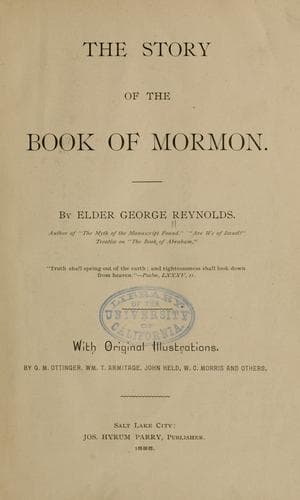
Book of Mormon; Latter Day Saint churches -- Doctrines; Latter Day Saints
This work the second Mosiah accomplished for the Nephites. When he
revised and codified the national law for the government of the
people under the Judges, he abolished the local distinctive rates
and introduced one universal standard. Of the ratios of the various
weights and measures, either before or after the enactment of Mosiah's
wise law, we are told nothing in the Book of Mormon; it is simply
stated that the Nephites had not adhered to the standards in use among
the Jews, but had altered their reckoning and their measures, very
frequently as caprice, convenience, or local exclusiveness inspired. As
to the ratios of the coins legalized by Mosiah's code they are highly
artistic, evince a large acquaintance with monetary matters and point
to a high degree of civilization as then existing among the Nephites.
The following is the table of these coins as given in the Book of
Mormon:
GOLD COINS. SILVER COINS.
1 Senine equal to 1 Senum.
1 Seon, 2 Senines, " 1 Amnor.
1 Shum, 4 " " 1 Ezrom.
1 Limnah, 7 " " 1 Onti.
Of smaller coins--
1 Shiblon was equal to half a Senine or Senum.
1 Shiblum was equal to a quarter of a Senine or Senum.
1 Leah was equal to an eighth of a Senine or Senum.
While an Antion of gold was equal to three Shublons.
Though not directly so stated, we judge from the context that the
Shiblon, the Shiblum and the Leah were silver coins.
The names of these coins seem to be identical with, or derived
from those of familiar persons or places. Thus we have a Leah, a
Shiblon,[13] and an Amnor,[14] all names of persons. Also an Antion,
which word is found in Antionah[15] and Antionum,[16] a Shiblum which
differs from Shiblom[17] only in one letter, and a Shublon from
Shiblon,[18] and a Limnah from Limhah,[19] to the same extent.
This custom of naming coins after well-known or distinguished persons
is a practice not confined to the Nephites. Other nations have done the
same; as for instance, in France a twenty-franc gold piece is called a
Napoleon.
One little item that in itself may appear trivial is not without its
weight in the consideration of the minor or incidental evidences of
the truth of the Book of Mormon. A measure of barley is especially
mentioned as the unit of value on which the monetary system, or the
value of the coins of the Nephites was based. One senine was worth one
measure of barley, and its multiples were, of course, multiples of this
measure of barley, but we have no information as to what the contents
of this measure may have been.[20]
Now the old English unit of measurement was a barley-corn, or grain
of barley. Three barley-corns make one inch, is the way the table
commenced.
Public-domain text, read in full here on John Shaqi.
Reviews
Reviews
No reviews yet
Be the first to share your thoughts on this work.
Elsewhere in the archive
Join the Discussion
Join the discussion
Sign in to leave a comment or review.
Sign InorCreate an account