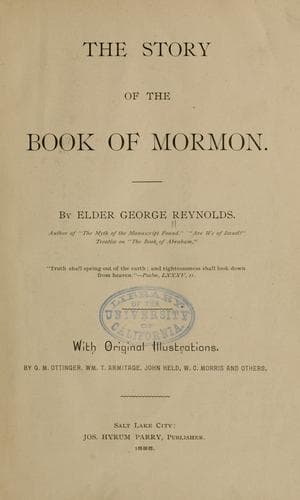
Book of Mormon; Latter Day Saint churches -- Doctrines; Latter Day Saints
As the course of the river Sidon was from south to north, it is but
reasonable to conclude that when the words above and below are used,
when reference is made to places on its banks or in its neighborhood,
that above means south and below, north. This is a very common mode of
expression in such cases.
MELEK.--The boundaries of this land are very indistinctly stated by the
inspired writer of the Book of Alma, for it is in that book alone that
it is mentioned. However, two things are positively stated (chapter
_viii._), namely, that it was west of the river Sidon, and that it
extended westward as far as the narrow strip of wilderness which ran
north and south between the mountains and Pacific Ocean. We imagine
that its eastern borders touched the land of Zarahemla and from thence
it stretched out as far as the country proved habitable, as it appears
to have had a large population, judging from the account given of
Alma's ministrations (B. C. 82). That it embraced a large district of
country is proven by the fact that when Alma had finished his labors
in the city of Melek, he traveled three days' journey on the north of
the land of Melek before he came to the city of Ammonihah (_Alma viii.
6_). In later years, when it was considered unsafe for the Ammonites
to remain longer in Jershon they were removed to Melek, the proximity
of which to Zarahemla, as well as its remoteness from the lands of the
Lamanites, rendered it admirably adapted as a place of safety for that
persecuted people.
AMMONIHAH.--When Alma had made the three days' journey spoken of above,
he reached Ammonihah the country around which city was called by
the same name. From the text of the passage some conclude that Alma
traveled northward from Melek, but to us it conveys the idea that
the prophet journeyed three days westward along or near the northern
boundary of that land. We are confirmed in this opinion by the
statement made in another place regarding Ammonihah's proximity to that
portion of the wilderness which ran along the sea shore (_Alma xxii.
27_). In Alma (_xvi. 2_), it is stated: The armies of the Lamanites had
come in upon the wilderness side, unto the borders of the land, even
into the city of Ammonihah. If Ammonihah had been situated three days'
journey north of Melek, we suggest that it could not have been near
that portion of the wilderness which the Lamanites so easily reached
without discovery; for a march due north would have taken them close
to, or actually through the lands of Minon, Noah, Melek and Zarahemla,
the most thickly populated portions of the country; or, to have avoided
these, they must have taken a circuitous route of immense length and
great danger. Then when they attempted to retire, their retreat, owing
to their great distance from Nephi, would have most assuredly been cut
off, as was the case with the Lamanite general Coriantumr under these
conditions.
Public-domain text, read in full here on John Shaqi.
Reviews
Reviews
No reviews yet
Be the first to share your thoughts on this work.
Elsewhere in the archive
Join the Discussion
Join the discussion
Sign in to leave a comment or review.
Sign InorCreate an account