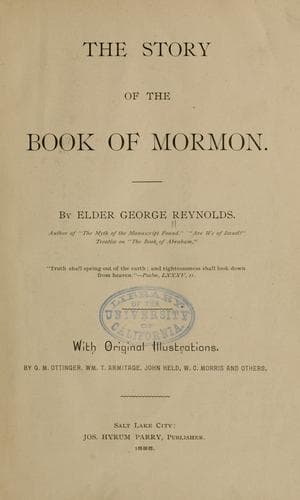
Book of Mormon; Latter Day Saint churches -- Doctrines; Latter Day Saints
The Gadiantons were at first (B. C. 52) apparently a band of robbers
and murderers bound together by the most horrible oaths of secrecy and
satanic covenants to aid and shield each other in whatever sins and
iniquities they might commit. These covenants did not originate with
Gadianton or any of his crew. They were as old as the days of Cain,
into whose ear the son of perdition whispered these blood-thirsty and
infernal suggestions. These same secret societies flourished among
the antediluvians; and had place with the Jaredites and other peoples
of antiquity. In the end they invariably wrought ruin and destruction
wherever they found a foothold. To their abominations can be traced the
fall and extinction of both the Jaredite and Nephite races.
As time went on, the Gadiantons among the Nephites aspired to rule
the republic. When, by their combinations, they could not carry their
points at the elections, they would murder, or attempt to murder, any
judge or other officer who was distasteful to them, and place a more
acceptable man in his seat. So fell more than one of the Nephite chief
judges. But they frequently had no need to do this, for as the people
increased in iniquity they could easily carry the majority or the voice
of the people with them. In this way several of their number were
elected to the chief judgeship.
After the times of the conversion of the Lamanites by Lehi and Nephi
(B. C. 30) the Gadianton robbers took their place in the history of
ancient America. The divisions then became the righteous Nephites and
Lamanites on one side, and the Gadiantons on the other. And, strange as
it may appear, these robber bands received greater encouragement and
attained to greater power among the Nephites than among the Lamanites;
but the fact is, that at that era the Lamanites were a growing race,
while the Nephites were a decaying one.
Public-domain text, read in full here on John Shaqi.
Reviews
Reviews
No reviews yet
Be the first to share your thoughts on this work.
Elsewhere in the archive
Join the Discussion
Join the discussion
Sign in to leave a comment or review.
Sign InorCreate an account