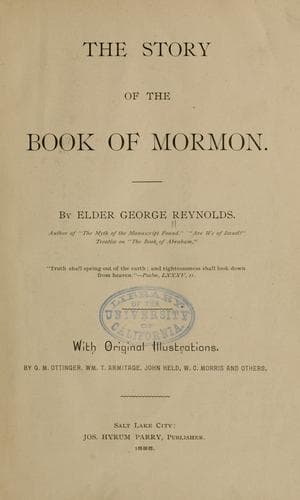
Book of Mormon; Latter Day Saint churches -- Doctrines; Latter Day Saints
It was the first year of Alma's reign. Could our readers have taken
a glimpse at the fair capital of the Nephites at that time (B. C.
91), already rich in the awards of human industry, combined with the
lavish productions of nature in that much favored land, they might have
noticed in the principal street, a portly, handsome man, manifesting
in his carriage the evidence of great bodily strength, combined with
vanity, self-sufficiency and subtlety. They might have observed that
his raiment was made of the finest fabrics that the looms of Zarahemla
could produce, lavishly embroidered and ornamented with labors of the
cunning workman in silk, in feathers and the precious metals, whilst
at his side hung a richly decorated sword. This man was no king, no
governor, no general of the armies of Israel; he was simply Nehor,
the successful religious charlatan of the hour, to whom the unstable
listened and the weak-minded flocked. His teachings had at any rate
the interest of novelty to the Nephites, yet some of his theories were
older than Idumea. They had been rejected in the counsels of heaven
before Lucifer, the son of the morning, fell. He would save all men in
their sins and with their sins; he abolished hell, established a paid
order of priests, and taught doctrines so liberal that every man could
be a member of his church and yet continue to gratify every vice his
nature inclined to. For this liberality of doctrine, Nehor expected
in return liberality of support for himself and assistants, in which
anticipation he was not disappointed. Many adopted his heresies; his
success fired his zeal and developed his vanity. He was so used to the
sycophancy of his converts that he was restive under contradiction,
and when Gideon, the aged patriot, and teacher in the true church,
one day met him in the streets of Zarahemla and upbraided him for his
wicked course, neither respecting his great age nor his many virtues,
Nehor drew his sword and smote him till he died. For this wilful and
unprovoked crime, the murderer was tried, convicted, and afterward
executed. His execution took place on the hill Manti, and, from the way
in which his death is spoken of, we imagine that he was hanged.
Though Nehor's shameful life was thus ended, unfortunately his doctrine
did not die with him. It was too pleasant to those who desired to gain
heaven without a life of righteousness. Consequently it spread widely
through the teachings of his followers. In later years the traitorous
Amlicites, the apostate Amalekites, the blood-thirsty Amulonites and
Ammonihahites, were all believers in his soul-destroying doctrines.
The bloodshed, the misery produced, the treasure expended through the
wickedness and folly of these base creatures, cannot be computed.
Public-domain text, read in full here on John Shaqi.
Reviews
Reviews
No reviews yet
Be the first to share your thoughts on this work.
Elsewhere in the archive
Join the Discussion
Join the discussion
Sign in to leave a comment or review.
Sign InorCreate an account