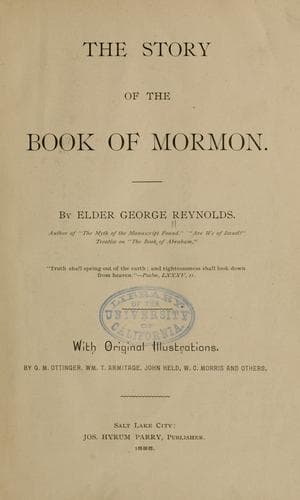
Book of Mormon; Latter Day Saint churches -- Doctrines; Latter Day Saints
This was the case with the Zoramites. They claimed to be a chosen and
a holy people, separate from their fellow-men, and elected of God to
eternal salvation, while all around were predestined to be cast down
to hell. This atrocious creed naturally resulted in its adherents and
advocates being puffed up in vanity and consumed with pride. They
became haughty, uncharitable and tyrannical, and oppressors of their
poorer neighbors. They covered their bodies with the finest apparel,
and profusely adorned their persons with costly ornaments of gold and
jewels. In their arrogance and self-righteousness they became the
Pharisees of their age and country; but in other phases of iniquity
they far exceeded their counterparts in the Holy Land. They bowed down
to idols, denied the coming of Christ, declared the doctrine of the
atonement to be a foolish tradition, and, like many of the sects of
modern Christendom, they misinterpreted the teachings of holy scripture
with regard to the being of God. Their declaration of faith was: Holy,
holy God; we believe that thou art God, and we believe that thou art
holy, and that thou wast a spirit, and that thou art a spirit, and
that thou wilt be a spirit forever.
This strange medley of ideas gave birth to corresponding vagaries of
worship. They left off praying. Being chosen and elected to be God's
holy children, they had no need of prayer. Once a week they assembled
in their synagogues and went through an empty form, which was a little
prayer, a little praise and considerable self-glorification. Having
done this, they never mentioned God or holy things again throughout the
week; indeed, it was a portion of their creed that their synagogues
were the only places in which it was lawful to talk or think of
religious matters.
Their ceremonies were as absurd as their creed. In the centre of
each of their synagogues was erected a holy stand, or pulpit, called
rameumptom, which stood high above the congregation. From the slight
description given of it in the book of Alma we judge it may have been
somewhat pyramidical in form, the top being only large enough for one
person to stand upon. Each worshiper mounted to the top, stretched
out his hands toward heaven, and, in a loud voice, repeated their set
form of worship. Having done this, he descended and another took his
place, and so on, until all who desired to go through the mummery had
satisfied their conscience or gratified their pride.
Public-domain text, read in full here on John Shaqi.
Reviews
Reviews
No reviews yet
Be the first to share your thoughts on this work.
Elsewhere in the archive
Join the Discussion
Join the discussion
Sign in to leave a comment or review.
Sign InorCreate an account