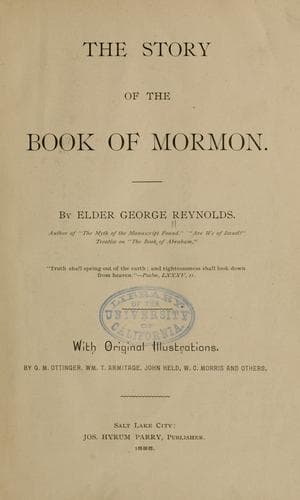
Book of Mormon; Latter Day Saint churches -- Doctrines; Latter Day Saints
Like many of the ancient patriarchs, when they felt that their mortal
career was drawing to its close, he called his sons to him, and gave
them his last charge and blessing, speaking to each as the spirit
of instruction and prophecy inspired. To Helaman, his eldest, he
transferred the custody of the sacred plates, with many words of
warning and caution regarding them. With hearts strengthened and
renewed by the inspiration of his fervent admonitions, his sons went
forth among the people; nor could Alma himself rest while there was a
soul to save or a wrong to make right. He also went forth once again in
the spirit of his holy calling, and raised his voice in advocacy of the
principles of the everlasting gospel.
It was in the nineteenth year of the Judges (B. C. 73), that Alma took
his beloved son, Helaman, and after having discovered, through divers
questions, the strength and integrity of his faith, he prophesied to
him of many important events in the distant future, especially with
regard to the destruction of the Nephites. This prophecy he commanded
him to record on the plates, but not to reveal to anyone. Alma then
blessed Helaman, also his other sons; indeed he blessed all who should
stand firm in the truth of Christ from that time forth. Shortly after
this he departed out of the land of Zarahemla, as if to go to the land
of Melek, and was never heard of more. Of his death and burial no men
were witnesses. Then the saying went abroad throughout the church that
the Lord had taken him, as he beforetime had taken Moses. This event
occurred exactly one hundred years from the time of the elder Alma's
birth.
After the departure of Alma we learn no more of the life of his
associate Zeezrom, though his name and teachings are more than once
referred to by later servants of God. We also read of a city of
Zeezrom, and, as it was the custom of the Nephites to name their
cities, towns and villages after whoever founded them, it is highly
probable that, in the colonization of the country so vigorously carried
on in the age that these men lived, he commenced the building of this
place, and it would not be unreasonable to believe that he dwelt in the
midst of its citizens as their high priest or chief judge.
Public-domain text, read in full here on John Shaqi.
Reviews
Reviews
No reviews yet
Be the first to share your thoughts on this work.
Elsewhere in the archive
Join the Discussion
Join the discussion
Sign in to leave a comment or review.
Sign InorCreate an account