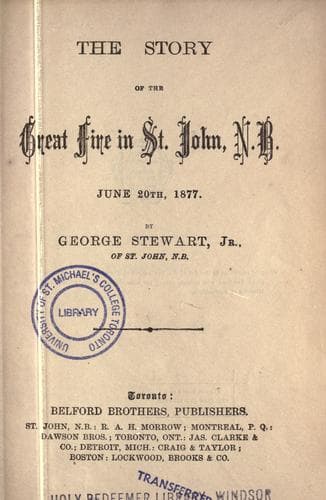
The Story of the Great Fire in St. John, N.B., June 20th, 1877Stewart, George
History
The Story of the Great Fire in St. John, N.B., June 20th, 1877
Stewart, George
Saint John (N.B.) -- Fire, 1877
opinion, and it is curious to observe how widely diversified these
opinions are. The cautious man places it at fifteen millions, and his
hot blooded and visionary friend with equal show of reason estimates the
loss at nearly fifty millions. The estimate ranges widely and wildly.
The books of the assessors on examination show a loss to property of
much less value than even the owners put upon it before the fire. But
one can see how fallacious these results are, when the reader learns
that in making up the assessments the assessors value a merchant's stock
at not what it is, but what in their opinion they think it should be.
For instance, a man has three hundred thousand dollars worth of stock in
warehouse. He really owns about fifty thousand dollars worth and owes
for the balance. He is not taxed on his debts but on what he is worth.
Yet the fire carried away the sum total of the goods in his possession.
The assessors' books show hardly a tithe of the actual value of the
loss. It can only be correctly stated after a thorough examination, and
as nearly as can be ascertained the entire destruction throughout the
city reaches upwards of twenty-seven millions of dollars. This is the
loss in solid value. But that much money will not replace the goods
thus destroyed. There were many things burned which were of what might
be called fancy value, and which money can in no way replace. And in
making our estimate these things have been valued only nominally. The
loss, therefore, in round figures, is not a whit below the amount we
have given, $27,000,000. The talk about taxable property is all
nonsense. Every man who says so, knows that he is talking nonsense.
Hardly a man lives to-day who is taxed in the proportion that he should
be. The richer a man is, the more easily he can hide his wealth, and an
examination of the assessment books will enable any reader to find a
hundred examples in proof of this. Another argument is brought forward.
We are told that the land is not burned up, and in that land there is
great value. That is true enough, every word of it. The land is not
burned out of existence. It is still where it was, but it is by no means
as valuable as it was before the fire. A thousand circumstances were
brought to bear on it, locality, desirability, and necessity, and all
these had an influence in enhancing its value. Most of these reasons,
and cogent reasons they were too at the time, have now gone out with the
fire. Men who thought they must have a piece of land because it was in a
good situation, and because it was located near their own lots, were
ready to buy what they wanted at a good price, often merely to carry out
some hobby or idea paramount in their minds. But these ideas have
vanished. This hobby can be ridden no longer. He can have the lot now if
he wants it, at a good deal lower rate than he offered for it, but he
can't afford it. The owner's means are swept away, and he cannot afford
Public-domain text, read in full here on John Shaqi.
Reviews
Reviews
No reviews yet
Be the first to share your thoughts on this work.
Elsewhere in the archive
Join the Discussion
Join the discussion
Sign in to leave a comment or review.
Sign InorCreate an account