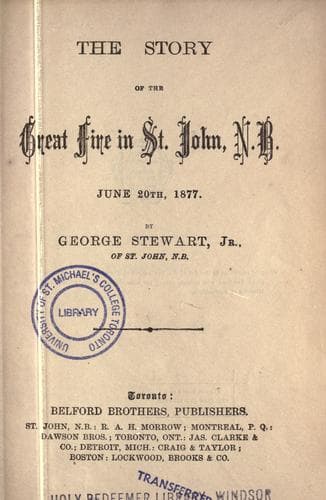
The Story of the Great Fire in St. John, N.B., June 20th, 1877Stewart, George
History
The Story of the Great Fire in St. John, N.B., June 20th, 1877
Stewart, George
Saint John (N.B.) -- Fire, 1877
At five o'clock the fire had reached its height. The blocks from Main
Street to High Street, inclusive, were completely obliterated, and only
gaunt chimneys remained. From High Street to the very water's edge the
flames sped on unresisted. Camden Street was burning, the large houses
on the foot of Portland Street, the houses from Temperance Hall, in
Simonds Street to Thomson's slip were consumed. Rankin's wharf with
immense piles of dressed lumber was threatened with immediate
extinction. The steamers "Ida Whittier," "Xyphus," and "Victor," were for
a time in danger. Three tug boats arrived opportunely, and the water
which they threw saved the wharf and lumber. At half-past eight the fire
was subdued.
The property destroyed consisted of all the houses in Main Street
between Jones's corner and Orange corner; all on Chapel Street, all on
Acadia Street except a small block and the greater part of Chapel
Street; all along the east side and part of the west side of Portland
Street, the east side of Simonds Street from High Street to the water,
and both sides of Camden Street. Of course a great deal of drunkenness
prevailed and numerous arrests were made. Thieving, as usual, was
largely indulged in.
The saddest event of the day was the loss of life. George Baxter, a ship
carpenter, who dwelt in High street, was found in a charred state in the
ruins of his house. It is thought he went in to save some of his
effects, and being unable to make his way out again he was smitten to
the ground and suffered one of the most terrible of deaths. The other
casualties were John Henry Maher, slightly injured, James Ennis badly
cut on the head. Nicholas Ryan fell off Dickinson's house, Chapel
Street, and sustained serious bruises. Mrs. Reed was struck by a falling
ladder. John Cobalan, jr., had one of his fingers broken, and Mrs.
Nowlan was slightly hurt. Wm. Carr and James Kennedy were injured
slightly.
The destruction of the Methodist Church is a very serious loss. It was
built in the year 1841, and succeeded the structure built in 1828, which
was destroyed in the former year. The first trustees were Alex. McLeod,
Samuel H. McKee, George Whittaker, William Nesbit, H. Hennigar, Robert
Chestnut, Robert Robertson, G. T. Ray, John B. Gaynor, George Lockhart,
James Bustin, John Owens and Francis Jordan, Rev. Messrs. R. Williams,
J. B. Story, and S. Busby were strong supporters of the church in its
young days and were long identified with its interests. On the first
Sunday after the fire of 1841 the congregation met in the open air and
prayed and sang hymns. The Rev. Mr. Allen addressed the people from a
rock. Rev. Mr. Teed was the pastor at the time of the present fire. When
he came to preside over its destinies he found the church struggling
with a debt, and he worked with great zeal to free it from this burden.
The Temperance Hall was one of the most useful institutions in the town,
and many will deplore the destruction of this building.
Public-domain text, read in full here on John Shaqi.
Reviews
Reviews
No reviews yet
Be the first to share your thoughts on this work.
Elsewhere in the archive
Join the Discussion
Join the discussion
Sign in to leave a comment or review.
Sign InorCreate an account