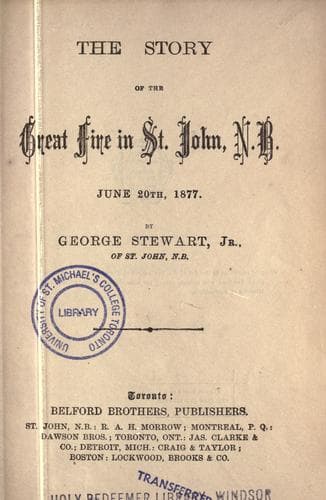
The Story of the Great Fire in St. John, N.B., June 20th, 1877Stewart, George
History
The Story of the Great Fire in St. John, N.B., June 20th, 1877
Stewart, George
Saint John (N.B.) -- Fire, 1877
Chubb's Corner--the home of the curb stone broker, and the place where
more gossip has been talked during the last forty years than would
furnish the stock-in-trade of forty well-organized sewing circles--was
an early victim, for it went down with Furlong's palace about the hour
of six. The mention of Chubb's Corner awakens a thousand memories. For
many years it enjoyed the distinction of being the great centre of
commercial speculation. Men came here to meet men who had money to lend,
and those who had none came to borrow it. Stocks and merchandise changed
hands on this spot a dozen times a day, and the cautious bill-broker
who never had any funds of his own to lend, came here to scent the
financial air. In this cheerful spot money was subject to the
fluctuations of the market with a vengeance. The rate--aye, there's the
rub--"if we can only agree about _that_," said the note-shaver, "I think
I may take the paper. 'The man is a good man,'" he continued,
unconsciously quoting Shakespeare, "and I think I may take his bond,"
and though nothing was said about the pound of flesh in the event of the
notes not being paid at maturity, the modern Shylock meant it all the
same, and was as equally determined to get it, too, as the old gentleman
we see on the stage rubbing his hands together, and making horrible
faces at the audience and the Christian merchant Antonio. The rate in
this grim corner was not measured by the consciences of the
money-lenders, but by the necessities of the applicant. One could tell
in a much less expensive way than by borrowing money of these gentry,
whether they were getting a good price for their coin or not, by simply
watching their faces during the operation. The face of the note-shaver
is a barometer. It requires no regulating and it is always correct.
There, quick, watch it now. See how long the face is. No, he has no
money himself, but--Ah, that's it, now watch. See, observe the
countenance, listen to that chuckle? Yes, what is he chuckling about?
Oh, that's nothing, only habit; now the face is hanging up again, and it
is ready for observation. The lender is telling the borrower how
difficult it is to get money, and how much Smith had to pay for a thirty
days' loan yesterday. This is of no interest to Jones, who is hanging
on the words of Mr. Shylock as a lover drinks in the soft nothings of
his mistress, but it gives the lender opportunities to find out how
"hard up" his victim is. Now watch the face again. Still long and
bilious-looking. Twenty per cent. is not so high. It's only five dollars
off of a hundred, and look at the time three months--and it falls due on
Sunday, too. You'll get a day's interest out of me for nothing, you
rogue. The face is positively joyous. The eyes snap and sparkle. The
countenance has become quite round and full, and there are bright spots
on the cheeks. The extra day without interest did it, and the two go off
arm in arm. But after all they are not happy; one has paid too much, and
Public-domain text, read in full here on John Shaqi.
Reviews
Reviews
No reviews yet
Be the first to share your thoughts on this work.
Elsewhere in the archive
Join the Discussion
Join the discussion
Sign in to leave a comment or review.
Sign InorCreate an account