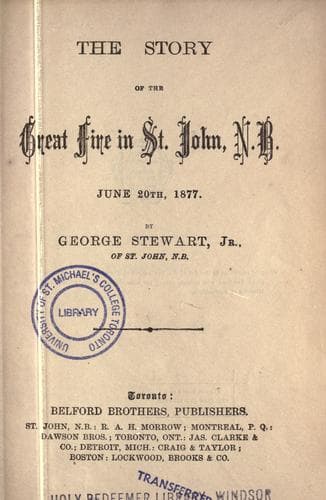
The Story of the Great Fire in St. John, N.B., June 20th, 1877Stewart, George
History
The Story of the Great Fire in St. John, N.B., June 20th, 1877
Stewart, George
Saint John (N.B.) -- Fire, 1877
The old Commercial Bank building which was lately completely altered
and renovated internally, was situate on the south-east corner of Prince
William and Princess Streets. The corner stone was laid in 1839, and a
grand Masonic demonstration took place, Rev. Dr. B. G. Gray officiating.
Henry Gilbert Esq., was the President of the Commercial Bank at the
time. It was used latterly for the civic offices, and the Water
Commissioners had an office on the ground flat. _The Daily Telegraph_
newspaper occupied the old wooden building adjoining, and about which
notice is given in the first chapter of this history. Mr. Elder, the
enterprising editor and proprietor of the paper, is a heavy loser by the
fire. Not only did he lose his well-equipped printing office and
appliances, his splendid reference library and collection of historic
data, the gatherings of many years, but his bound fyles also, and in
fact everything he possessed vanished forever.
The Bank of New Brunswick was for a long time deemed safe. It is true
that the merchants hurried in with their books when the fire was still
raging a quarter of a mile away, but the old building which was burned
inside, exhibited after the fire, walls and pillars as strong and
vigorous as they were half a century ago. The vaults preserved their
contents, and millions of money were thus plucked from the burning. The
old bank was an edifice in which the people took pride. It was a hale
old veteran that had passed through many a disaster. When financial
troubles darkened the days of the people, when the dread cholera spread
disease and death in households, when fires laid waste the best acres
of our territory, the old bank still stood erect, and withstood the
shock which threatened her on every side. It succumbed this time, but
only in a partial way, for its pillars and a portion of its walls are as
stalwart as of yore. In May, 1821, a general meeting was held of the
stockholders of the banking company that had been organized the year
before. At this meeting some honoured names were read, and the following
gentlemen were present: Henry Gilbert, Hon. John Robinson, Nehemiah
Merritt, Wm. Black, Ezekiel Barlow, Thos. Millidge, Ward Chipman, jr.,
Zalmon Wheeler, Hugh Johnston, jr., Robert W. Crookshank, Robert Parker,
jr., Stephen Wiggins, and Hugh Johnston, senr. On the seventh day of May
the directors were chosen, and the bank was ready for business. The
first President was the Hon. John Robinson; and the other Directors for
the year were Wm. Black, Ezekiel Barlow, Lewis Bliss, Ward Chipman, jr.,
Robert W. Crookshank, senr., Henry Gilbert, Hugh Johnston, Nehemiah
Merritt, Thos. Millidge, Robert Parker, jr., Zalmon Wheeler, and Stephen
Wiggins. Of these but one lives to-day, Lewis Bliss, Esq., who, at last
accounts was in London, England. The Hon. J. D. Lewin was made President
in 1857, and Wm. Girvan, Esq., whose great industry is proverbial, was
chosen cashier, March 1st, 1862. Mr. Girvan, on taking charge of his
Public-domain text, read in full here on John Shaqi.
Reviews
Reviews
No reviews yet
Be the first to share your thoughts on this work.
Elsewhere in the archive
Join the Discussion
Join the discussion
Sign in to leave a comment or review.
Sign InorCreate an account