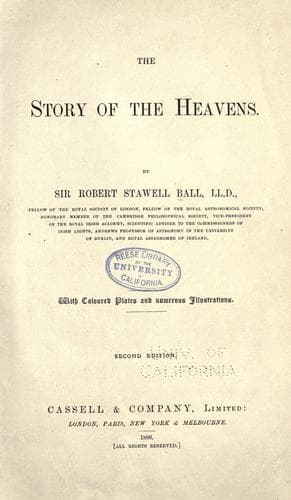
The Story of the HeavensBall, Robert S. (Robert Stawell)
History
The Story of the Heavens
Ball, Robert S. (Robert Stawell)
Astronomy
If a planet revolved around the sun in a truly circular path, of which
the sun was always at the centre, it is then obvious that the distance
from the sun to the planet, being always equal to the radius of the
circle, must be of constant magnitude. Now, there can be no doubt that
the distance from the sun to each planet is approximately constant; but
when accurate observations are made, it becomes clear that the distance
is not absolutely so. The variations in distance may amount to many
millions of miles, but, even in extreme cases, the variation in the
distance of the planet is only a small fraction--usually a very small
fraction--of the total amount of that distance. The circumstances vary
in the case of each of the planets. The orbit of the earth itself is
such that the distance from the earth to the sun departs but little from
its mean value. Venus makes even a closer approach to perfectly circular
movement; while, on the other hand, the path of Mars, and much more the
path of Mercury, show considerable relative fluctuations in the distance
from the planet to the sun.
It has often been noticed that many of the great discoveries in science
have their origin in the nice observation and explanation of minute
departures from some law approximately true. We have in this department
of astronomy an excellent illustration of this principle. The orbits of
the planets are nearly circles, but they are not exactly circles. Now,
why is this? There must be some natural reason. That reason has been
ascertained, and it has led to several of the grandest discoveries that
the mind of man has ever achieved in the realms of Nature.
In the first place, let us see the inferences to be drawn from the fact
that the distance of a planet from the sun is not constant. The motion
in a circle is one of such beauty and simplicity that we are reluctant
to abandon it, unless the necessity for doing so be made clearly
apparent. Can we not devise any way by which the circular motion might
be preserved, and yet be compatible with the fluctuations in the
distance from the planet to the sun? This is clearly impossible with the
sun at the centre of the circle. But suppose the sun did not occupy the
centre, while the planet, as before, revolved around the sun. The
distance between the two bodies would then necessarily fluctuate. The
more eccentric the position of the sun, the larger would be the
proportionate variation in the distance of the planet when at the
different parts of its orbit. It might further be supposed that by
placing a series of circles around the sun the various planetary orbits
could be accounted for. The centre of the circle belonging to Venus is
to coincide very nearly with the centre of the sun, and the centres of
the orbits of all the other planets are to be placed at such suitable
distances from the sun as will render a satisfactory explanation of the
gradual increase and decrease of the distance between the two bodies.
Public-domain text, read in full here on John Shaqi.
Reviews
Reviews
No reviews yet
Be the first to share your thoughts on this work.
Elsewhere in the archive
Join the Discussion
Join the discussion
Sign in to leave a comment or review.
Sign InorCreate an account