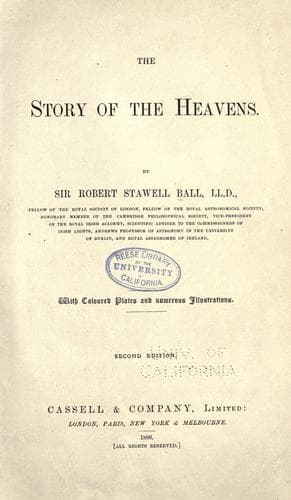
The Story of the HeavensBall, Robert S. (Robert Stawell)
History
The Story of the Heavens
Ball, Robert S. (Robert Stawell)
Astronomy
Admitting the existence of this law, we can show that the planets must
revolve around the sun in elliptic paths with the sun in the common
focus. We can show that they must sweep over equal areas in equal times.
We can prove that the squares of the periodic times must be proportional
to the cubes of their mean distances. Still further, we can show how the
mysterious movements of comets can be accounted for. By the same great
law we can explain the revolutions of the satellites. We can account for
the tides, and for other phenomena throughout the Solar System. Finally,
we shall show that when we extend our view beyond the limits of our
Solar System to the beautiful starry systems scattered through space, we
find even there evidence of the great law of universal gravitation.
CHAPTER VI.
THE PLANET OF ROMANCE.
Outline of the Subject--Is Mercury the Planet nearest the
Sun?--Transit of an Interior Planet across the Sun--Has a Transit
of Vulcan ever been seen?--Visibility of Planets during a Total
Eclipse of the Sun--Professor Watson's Researches in 1878.
Provided with a general survey of the Solar System, and with such an
outline of the law of universal gravitation as the last chapter has
afforded us, we commence the more detailed examination of the planets
and their satellites. We shall begin with the planets nearest to the
sun, and then we shall gradually proceed outwards to one planet after
another, until we reach the confines of the system. We shall find much
to occupy our attention. Each planet is itself a globe, and it will be
for us to describe as much as is known of it. The satellites by which so
many of the planets are accompanied possess many points of interest. The
circumstances of their discovery, their sizes, their movements, and
their distances must be duly considered. It will also be found that the
movements of the planets present much matter for reflection and
examination. We shall have occasion to show how the planets mutually
disturb each other, and what remarkable consequences have arisen from
these influences. We must also occasionally refer to the important
problems of celestial measuring and celestial weighing. We must show how
the sizes, the weights, and the distances of the various members of our
system are to be discovered. The greater part of our task will
fortunately lead us over ground which is thoroughly certain, and where
the results have been confirmed by frequent observation. It happens,
however, that at the very outset of our course we are obliged to deal
with observations which are far from certain. The existence of a planet
much closer to the sun than those hitherto known has been asserted by
competent authority. The question is still unsettled, but the planet
cannot at present be found. Hence it is that we have called the subject
of this chapter, The Planet of Romance.
Public-domain text, read in full here on John Shaqi.
Reviews
Reviews
No reviews yet
Be the first to share your thoughts on this work.
Elsewhere in the archive
Join the Discussion
Join the discussion
Sign in to leave a comment or review.
Sign InorCreate an account