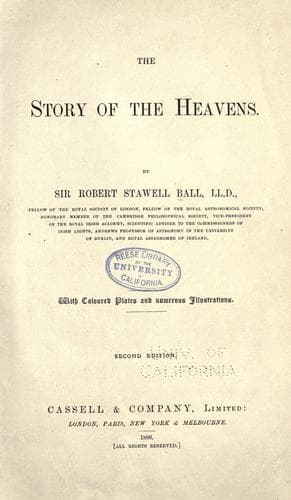
The Story of the HeavensBall, Robert S. (Robert Stawell)
History
The Story of the Heavens
Ball, Robert S. (Robert Stawell)
Astronomy
When the moon is interposed directly between the earth and the sun, the
brightness of day is temporarily exchanged for the gloom of night. If
the sky be free from clouds the stars spring forth, and can be seen
around the obscured sun. Even if a planet were quite close to the
luminary it would be visible on such an occasion if its magnitude were
comparable with that of Mercury. Careful preparation is necessary when
it is proposed to make a trial of this kind. The danger to be specially
avoided is that of confounding the planet with the ordinary stars, which
it will probably resemble. The late distinguished American astronomer,
Professor Watson, specially prepared to devote himself to this research
during the notable total eclipse in 1878. When the eclipse occurred the
light of the sun vanished and the stars burst forth. Among them
Professor Watson saw an object which to him seemed to be the long-sought
intra-Mercurial planet. We should add that this zealous observer saw
another object which he at first took to be the star known as Zeta in
the constellation Cancer. When he afterwards found that the recorded
place of this object did not agree so well as he expected with the known
position of this star, he came to the conclusion that it could not be
Zeta but must be some other unknown planet. The relative positions of
the two objects which he took to be planets agree, however, sufficiently
well, considering the difficulties of the observation, with the relative
positions of the stars Theta and Zeta Cancri, and it can now hardly be
doubted that Watson merely saw these two stars. He maintained, however,
that he had noticed Theta Cancri as well as the two planets, but without
recording its position. There is, however, a third star, known as 20
Cancri, near the same place, and this Watson probably mistook for Theta.
It is necessary to record that Vulcan has not been observed, though
specially looked for, during the eclipses which have occurred since
1878, and it is accordingly the general belief among astronomers that no
planet has yet been detected within the orbit of Mercury.
CHAPTER VII.
MERCURY.
The Ancient Astronomical Discoveries--How Mercury was first
found--Not easily seen--Mercury was known from the earliest
ages--Skill necessary in the Discovery--The Distinction of Mercury
from a Star--Mercury in the East and in the West--The
Prediction--How to Observe Mercury--Its Telescopic
Appearance--Difficulty of Observing its Appearance--Orbit of
Mercury--Velocity of the Planet--Can there be Life on the
Planet?--Changes in its Temperature--Transit of Mercury over the
Sun--Gassendi's Observations--Rotation of Mercury--The Weight of
Mercury.
Public-domain text, read in full here on John Shaqi.
Reviews
Reviews
No reviews yet
Be the first to share your thoughts on this work.
Elsewhere in the archive
Join the Discussion
Join the discussion
Sign in to leave a comment or review.
Sign InorCreate an account