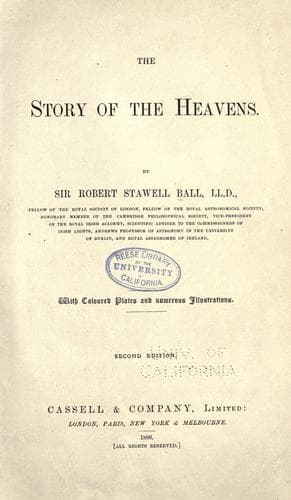
The Story of the HeavensBall, Robert S. (Robert Stawell)
History
The Story of the Heavens
Ball, Robert S. (Robert Stawell)
Astronomy
The facts which have been thoroughly established with regard to Mercury
are mainly numerical statements as to the path it describes around the
sun. The time taken by the planet to complete one of its revolutions is
eighty-eight days nearly. The average distance from the sun is about
36,000,000 miles, and the mean velocity with which the body moves is
over twenty-nine miles a second. We have already alluded to the most
characteristic and remarkable feature of the orbit of Mercury. That
orbit differs from the paths of all the other large planets by its much
greater departure from the circular form. In the majority of cases the
planetary orbits are so little elliptic that a diagram of the orbit
drawn accurately to scale would not be perceived to differ from a circle
unless careful measurements were made. In the case of Mercury the
circumstances are different. The elliptic form of the path would be
quite unmistakable by the most casual observer. The distance from the
sun to the planet fluctuates between very considerable limits. The
lowest value it can attain is about 30,000,000 miles; the highest value
is about 43,000,000 miles. In accordance with Kepler's second law, the
velocity of the planet must exhibit corresponding changes. It must sweep
rapidly around that part of his path near the sun, and more slowly round
the remote parts of his path. The greatest velocity is about
thirty-five miles a second, and the least is twenty-three miles a
second.
For an adequate conception of the movements of Mercury we ought not to
dissociate the velocity from the true dimensions of the body by which it
is performed. No doubt a speed of twenty-nine miles a second is enormous
when compared with the velocities with which daily life makes us
familiar. The speed of the planet is not less than a hundred times as
great as the velocity of the rifle bullet. But when we compare the sizes
of the bodies with their velocities, the velocity of Mercury seems
relatively much less than that of the bullet. A rifle bullet traverses a
distance equal to its own diameter many thousands of times in a second.
But even though Mercury is moving so much faster, yet the dimensions of
the planet are so considerable that a period of two minutes will be
required for it to move through a distance equal to its diameter.
Viewing the globe of the planet as a whole, the velocity of its movement
is but a stately and dignified progress appropriate to its dimensions.
Public-domain text, read in full here on John Shaqi.
Reviews
Reviews
No reviews yet
Be the first to share your thoughts on this work.
Elsewhere in the archive
Join the Discussion
Join the discussion
Sign in to leave a comment or review.
Sign InorCreate an account