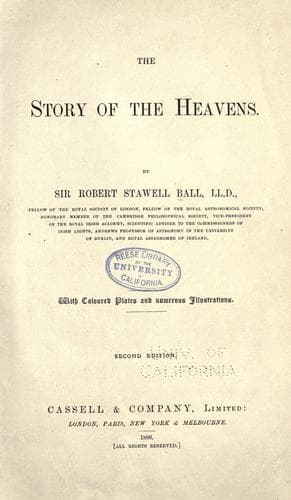
The Story of the HeavensBall, Robert S. (Robert Stawell)
History
The Story of the Heavens
Ball, Robert S. (Robert Stawell)
Astronomy
Who has not been delighted with the view of this glorious object? It is
not to be seen at all times. For months together the star of evening is
hidden from mortal gaze. Its beauties are even enhanced by the caprice
and the uncertainty which attend its appearance. We do not say that
there is any caprice in the movements of Venus, as known to those who
diligently consult their almanacs. The movements of the lovely planet
are there prescribed with a prosaic detail hardly in harmony with the
character usually ascribed to the Goddess of Love. But to those who do
not devote particular attention to the stars, the very unexpectedness of
its appearance is one of its greatest charms. Venus has not been
noticed, not been thought of, for many months. It is a beautifully clear
evening; the sun has just set. The lover of nature turns to admire the
sunset, as every lover of nature will. In the golden glory of the west a
beauteous gem is seen to glitter; it is the evening star--the planet
Venus. A few weeks later another beautiful sunset is seen, and now the
planet is no longer a point low down in the western glow; it has risen
high above the horizon, and continues a brilliant object long after the
shades of night have descended. Again, a little later, and Venus has
gained its full brilliancy and splendour. All the heavenly host--even
Sirius and even Jupiter--must pale before the splendid lustre of Venus,
the unrivalled queen of the firmament.
After weeks of splendour, the height of Venus at sunset diminishes, and
its lustre begins gradually to decline. It sinks to invisibility, and is
forgotten by the great majority of mankind; but the capricious goddess
has only moved from one side of the sky to the other. Ere the sun rises,
the morning star will be seen in the east. Its splendour gradually
augments until it rivals the beauty of the evening star. Then again the
planet draws near to the sun, and remains lost to view for many months,
until the same cycle of changes recommences, after an interval of a year
and seven months.
When Venus is at its brightest it can be easily seen in broad daylight
with the unaided eye. This striking spectacle proclaims in an
unmistakable manner the unrivalled supremacy of this planet as compared
with its fellow-planets and with the fixed stars. Indeed, at this time
Venus is from forty to sixty times more brilliant than any stellar
object in the northern heavens.
The beautiful evening star is often such a very conspicuous object that
it may seem difficult at first to realise that the body is not
self-luminous. Yet it is impossible to doubt that the planet is really
only a dark globe, and to that extent resembles our own earth. The
brilliance of the planet is not so very much greater than that of the
earth on a sunshiny day. The splendour of Venus entirely arises from the
reflected light of the sun, in the manner already explained with respect
to the moon.
Public-domain text, read in full here on John Shaqi.
Reviews
Reviews
No reviews yet
Be the first to share your thoughts on this work.
Elsewhere in the archive
Join the Discussion
Join the discussion
Sign in to leave a comment or review.
Sign InorCreate an account