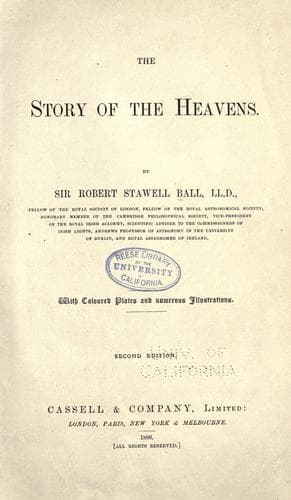
The Story of the HeavensBall, Robert S. (Robert Stawell)
History
The Story of the Heavens
Ball, Robert S. (Robert Stawell)
Astronomy
We have seen that the moon revolves so as to keep the same face always
turned towards the earth. We have now seen that the planets Venus and
Mercury each appear to revolve in such a way that they keep the same
face towards the sun. All these phenomena are of profound interest in
the higher departments of astronomical research. They are not mere
coincidences. They arise from the operation of the tides, in a manner
that will be explained in a later chapter.
It happens that our earth and Venus are very nearly equal in bulk. The
difference is hardly perceptible, but the earth has a diameter a few
miles greater than that of Venus. There are indications of the existence
of an atmosphere around Venus, and the evidence of the spectroscope
shows that water vapour is there present.
If there be oxygen in the atmosphere of Venus, then it would seem
possible that there might be life on that globe not essentially
different in character from some forms of life on the earth. No doubt
the sun's heat on Venus is greatly in excess of the sun's heat with
which we are acquainted, but this is not an insuperable difficulty. We
see at present on the earth, life in very hot regions and life in very
cold regions. Indeed, with each approach to the Equator we find life
more and more exuberant; so that, if water be present on the surface of
Venus and if oxygen be a constituent of its atmosphere, we might expect
to find in that planet a luxuriant tropical life, of a kind perhaps
analogous in some respects to life on the earth.
In our account of the planet Mercury, as well as in the brief
description of the hypothetical planet Vulcan, it has been necessary to
allude to the phenomena presented by the transit of a planet over the
face of the sun. Such an event is always of interest to astronomers, and
especially so in the case of Venus. We have in recent years had the
opportunity of witnessing two of these rare occurrences. It is perhaps
not too much to assert that the transits of 1874 and 1882 have received
a degree of attention never before accorded to any astronomical
phenomenon.
Public-domain text, read in full here on John Shaqi.
Reviews
Reviews
No reviews yet
Be the first to share your thoughts on this work.
Elsewhere in the archive
Join the Discussion
Join the discussion
Sign in to leave a comment or review.
Sign InorCreate an account