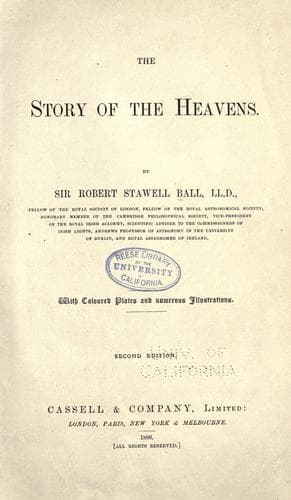
The Story of the HeavensBall, Robert S. (Robert Stawell)
History
The Story of the Heavens
Ball, Robert S. (Robert Stawell)
Astronomy
It may be asked, what is the advantage of devoting so much time and
labour to a celestial phenomenon like the transit of Venus which has so
little bearing on practical affairs? What does it matter whether the sun
be 95,000,000 miles off, or whether it be only 93,000,000, or any other
distance? We must admit at once that the enquiry has but a slender
bearing on matters of practical utility. No doubt a fanciful person
might contend that to compute our nautical almanacs with perfect
accuracy we require a precise knowledge of the distance of the sun. Our
vast commerce depends on skilful navigation, and one factor necessary
for success is the reliability of the "Nautical Almanac." The increased
perfection of the almanac must therefore bear some relation to increased
perfection in navigation. Now, as good authorities tell us that in
running for a harbour on a tempestuous night, or in other critical
emergencies, even a yard of sea-room is often of great consequence, so
it may conceivably happen that to the infinitesimal influence of the
transit of Venus on the "Nautical Almanac" is due the safety of a
gallant vessel.
But the time, the labour, and the money expended in observing the
transit of Venus are really to be defended on quite different grounds.
We see in it a fruitful source of information. It tells us the distance
of the sun, which is the foundation of all the great measurements of the
universe. It gratifies the intellectual curiosity of man by a view of
the true dimensions of the majestic solar system, in which the earth is
seen to play a dignified, though still subordinate, part; and it leads
us to a conception of the stupendous scale on which the universe is
constructed.
It is not possible for us, with a due regard to the limits of this
volume, to protract any longer our discussion of the transit of Venus.
When we begin to study the details of the observations, we are
immediately confronted with a multitude of technical and intricate
matters. Unfortunately, there are very great difficulties in making the
observations with the necessary precision. The moments when Venus enters
on and leaves the solar disc cannot be very accurately observed, partly
owing to a peculiar optical illusion known as "the black drop," whereby
Venus seems to cling to the sun's limb for many seconds, partly owing to
the influence of the planet's atmosphere, which helps to make the
observed time of contact uncertain. These circumstances make it
difficult to determine the distance of the sun from observations of
transits of Venus with the accuracy which modern science requires. It
seems therefore likely that the final determination of the sun's
distance will be obtained in quite a different manner. This will be
explained in Chapter XI., and hence we feel the less reluctance in
passing any from the consideration of the transit of Venus as a method
of celestial surveying.
Public-domain text, read in full here on John Shaqi.
Reviews
Reviews
No reviews yet
Be the first to share your thoughts on this work.
Elsewhere in the archive
Join the Discussion
Join the discussion
Sign in to leave a comment or review.
Sign InorCreate an account