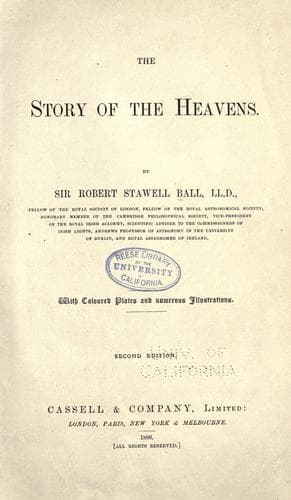
The Story of the HeavensBall, Robert S. (Robert Stawell)
History
The Story of the Heavens
Ball, Robert S. (Robert Stawell)
Astronomy
The earth is attended by one moon. Jupiter is attended by four
conspicuous moons. Mars is a planet revolving between the orbits of the
earth and of Jupiter. It is a body of the same general type as the earth
and Jupiter. It is ruled by the same sun, and all three planets form
part of the same system; but as the earth has one moon and Jupiter four
moons, why should not Mars also have a moon? No doubt Mars is a small
body, less even than the earth, and much less than Jupiter. We could not
expect Mars to have large moons, but why should it be unlike its two
neighbours, and not have any moon at all? So reasoned astronomers, but
until modern times no satellite of Mars could be found. For centuries
the planet has been diligently examined with this special object, and as
failure after failure came to be recorded, the conclusion seemed almost
to be justified that the chain of analogical reasoning had broken down.
The moonless Mars was thought to be an exception to the rule that all
the great planets outside Venus were dignified by an attendant retinue
of satellites. It seemed almost hopeless to begin again a research which
had often been tried, and had invariably led to disappointment; yet,
fortunately, the present generation has witnessed still one more attack,
conducted with perfect equipment and with consummate skill This attempt
has obtained the success it so well merited, and the result has been the
memorable detection of two satellites of Mars.
This discovery was made by Professor Asaph Hall, the distinguished
astronomer at the observatory of Washington. Mr. Hall was provided with
an instrument of colossal proportions and of exquisite workmanship,
known as the great Washington refractor. It is the product of the
celebrated workshop of Messrs. Alvan Clark and Sons, from which so many
large telescopes have proceeded, and in its noble proportions far
surpassed any other telescope ever devoted to the same research. The
object-glass measures twenty-six inches in diameter, and is hardly less
remarkable for the perfection of its definition than for its size. But
even the skill of Mr. Hall, and the space-penetrating power of his
telescope, would not have been able on ordinary occasions to discover
the satellites of Mars. Advantage was accordingly taken of that
memorable opposition of Mars in 1877, when, as we have already
described, the planet came unusually near the earth.
Public-domain text, read in full here on John Shaqi.
Reviews
Reviews
No reviews yet
Be the first to share your thoughts on this work.
Elsewhere in the archive
Join the Discussion
Join the discussion
Sign in to leave a comment or review.
Sign InorCreate an account