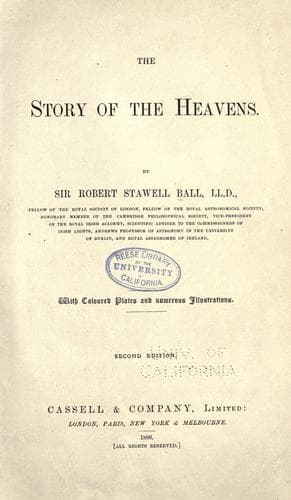
The Story of the HeavensBall, Robert S. (Robert Stawell)
History
The Story of the Heavens
Ball, Robert S. (Robert Stawell)
Astronomy
A few days' observation sufficed to show how this little body,
afterwards called Ceres, revolved around the sun, and how it circulated
in that vacant path intermediate between the path of Mars and the path
of Jupiter. Great, indeed, was the interest aroused by this discovery
and the influence which it has exercised on the progress of astronomy.
The majestic planets of our system had now to admit a much more humble
object to a share of the benefits dispensed by the sun.
After Piazzi had obtained a few further observations, the season for
observing this part of the heavens passed away, and the new planet of
course ceased to be visible. In a few months, no doubt, the same part of
the sky would again be above the horizon after dark, and the stars would
of course be seen as before. The planet, however, was moving, and would
continue to move, and by the time the next season had arrived it would
have passed off into some distant region, and would be again confounded
with the stars which it so closely resembled. How, then, was the planet
to be pursued through its period of invisibility and identified when it
again came within reach of observation?
This difficulty attracted the attention of astronomers, and they sought
for some method by which the place of the planet could be recovered so
as to prevent Piazzi's discovery from falling into oblivion. A young
German mathematician, whose name was Gauss, opened his distinguished
career by a successful attempt to solve this problem. A planet, as we
have shown, describes an ellipse around the sun, and the sun lies at a
focus of that curve. It can be demonstrated that when three positions of
a planet are known, then the ellipse in which the planet moves is
completely determined. Piazzi had on each occasion measured the place
which it then occupied. This information was available to Gauss, and the
problem which he had to solve may be thus stated. Knowing the place of
the planet on three nights, it is required, without any further
observations, to tell what the place of the planet will be on a special
occasion some months in the future. Mathematical calculations, based on
the laws of Kepler, will enable this problem to be solved, and Gauss
succeeded in solving it. Gauss demonstrated that though the telescope of
the astronomer was unable to detect the wanderer during its season of
invisibility, yet the pen of the mathematician could follow it with
unfailing certainty. When, therefore, the progress of the seasons
permitted the observations to be renewed, the search was recommenced.
The telescope was directed to the point which Gauss's calculations
indicated, and there was the little Ceres. Ever since its re-discovery,
the planet has been so completely bound in the toils of mathematical
reasoning that its place every night of the year can be indicated with a
fidelity approaching to that attainable in observing the moon or the
great planets of our system.
Public-domain text, read in full here on John Shaqi.
Reviews
Reviews
No reviews yet
Be the first to share your thoughts on this work.
Elsewhere in the archive
Join the Discussion
Join the discussion
Sign in to leave a comment or review.
Sign InorCreate an account