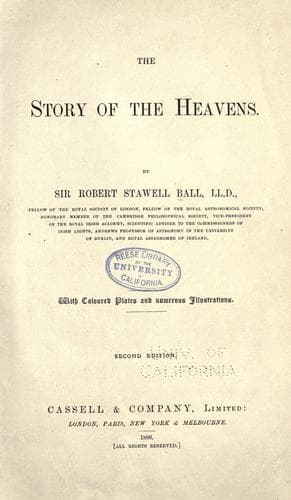
The Story of the HeavensBall, Robert S. (Robert Stawell)
History
The Story of the Heavens
Ball, Robert S. (Robert Stawell)
Astronomy
The astronomer about to seek for a new planet directs his telescope
towards that part of the sun's path which is on the meridian at
midnight; there, if anywhere, lies the chance of success, because that
is the region in which such a body is nearer to the earth than at any
other part of its course. He steadfastly compares his chart with the
heavens, and usually finds the stars in the heavens and the stars in the
chart to correspond; but sometimes it will happen that a point in the
heavens is missing from the chart. His attention is at once arrested; he
follows the object with care, and if it moves it is a planet. Still he
cannot be sure that he has really made a discovery; he has found a
planet, no doubt, but it may be one of the large number already known.
To clear up this point he must undertake a further, and sometimes a very
laborious, enquiry; he must search the Berlin Year-Book and other
ephemerides of such planets and see whether it is possible for one of
them to have been in the position on the night in question. If he can
ascertain that no previously discovered body could have been there, he
is then entitled to announce to his brother astronomers the discovery of
a new member of the solar system. It seems certain that all the more
important of the minor planets have been long since discovered. The
recent additions to the list are generally extremely minute objects,
beyond the powers of small telescopes.
Since 1891 the method of searching for minor planets which we have just
described has been almost abandoned in favour of a process greatly
superior. It has been found feasible to employ photography for making
charts of the heavens. A photographic plate is exposed in the telescope
to a certain region of the sky sufficiently long to enable very faint
telescopic stars to imprint their images. Care has to be taken that the
clock which moves the camera shall keep pace most accurately with the
rotation of the earth, so that fixed stars appear on the plate as sharp
points. If, on developing the plate, a star is found to have left a
trail, it is evident that this star must during the time of exposure
(generally some hours) have had an independent motion of its own; in
other words, it must be a planet. For greater security a second picture
is generally taken of the same region after a short interval. If the
place occupied by the trail on the first plate is now vacant, while on
the second plate a new trail appears in a line with the first one, there
remains no possible doubt that we have genuine indications of a planet,
and that we have not been led astray by some impurity on the plate or by
a few minute stars which happened to lie very closely together. Wolf,
of Heidelberg, and following in his footsteps Charlois, of Nice, have in
this manner discovered a great number of new minor planets, while they
have also recovered a good many of those which had been lost sight of
owing to an insufficiency of observations.
Public-domain text, read in full here on John Shaqi.
Reviews
Reviews
No reviews yet
Be the first to share your thoughts on this work.
Elsewhere in the archive
Join the Discussion
Join the discussion
Sign in to leave a comment or review.
Sign InorCreate an account