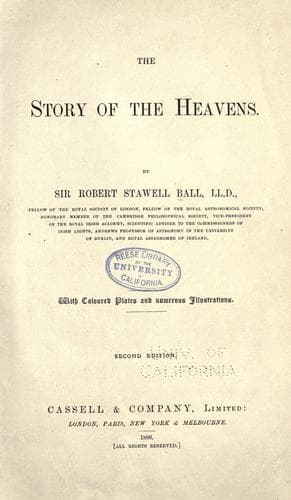
The Story of the HeavensBall, Robert S. (Robert Stawell)
History
The Story of the Heavens
Ball, Robert S. (Robert Stawell)
Astronomy
A satellite also assumes another remarkable situation when in the course
of transit over the face of the planet. The satellite itself is not
always very easy to see in such circumstances, but the beautiful shadow
which it casts forms a sharp black spot on the brilliant orb: the
satellite will, indeed, frequently cast a visible shadow when it passes
between the planet and the sun, even though it be not actually at the
moment in front of the planet, as it is seen from the earth.
The periods in which the four principal moons of Jupiter revolve around
their primary are respectively, 1 day 18 hrs. 27 min. 34 secs. for the
first; 3 days 13 hrs. 13 min. 42 secs., for the second; 7 days 3 hrs. 42
min. 33 secs, for the third; and 16 days 16 hrs. 32 min. 11 secs. for
the fourth. We thus observe that the periods of Jupiter's satellites are
decidedly briefer than that of our moon. Even the satellite most distant
from the great planet requires for each revolution less than two-thirds
of an ordinary lunar month. The innermost of these bodies, revolving as
it does in less than two days, presents a striking series of ceaseless
and rapid changes, and it becomes eclipsed during every revolution. The
distance from the centre of Jupiter to the orbit of the innermost of
these four attendants is a quarter of a million miles, while the radius
of the outermost is a little more than a million miles. The second of
the satellites proceeding outwards from the planet is almost the same
size as our moon; the other three bodies are larger; the third being the
greatest of all (about 3,560 miles in diameter). Owing to the minuteness
of the satellites as seen from the earth, it is extremely difficult to
perceive any markings on their surfaces, but the few observations made
seem to indicate that the satellites (like our moon) always turn the
same face towards their primary. Professor Barnard has, with the great
Lick refractor, seen a white equatorial belt on the first satellite,
while its poles were very dark. Mr. Douglass, observing with Mr.
Lowell's great refractor, has also reported certain streaky markings on
the third satellite.
A very interesting astronomical discovery was that made by Professor
E.E. Barnard in 1892. He detected with the 36-inch Lick refractor an
extremely minute fifth satellite to Jupiter at a distance of 112,400
miles, and revolving in a period of 11 hrs. 57 min. 22.6 secs. It can
only be seen with the most powerful telescopes.
Public-domain text, read in full here on John Shaqi.
Reviews
Reviews
No reviews yet
Be the first to share your thoughts on this work.
Elsewhere in the archive
Join the Discussion
Join the discussion
Sign in to leave a comment or review.
Sign InorCreate an account