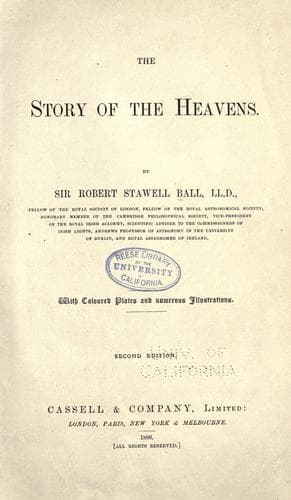
The Story of the HeavensBall, Robert S. (Robert Stawell)
History
The Story of the Heavens
Ball, Robert S. (Robert Stawell)
Astronomy
But Saturn possesses an interest for a far more numerous class of
persons than those who are specially devoted to astronomy. It is of
interest, it must be of interest, to every cultivated person who has the
slightest love for nature. A lover of the picturesque cannot behold
Saturn in a telescope without feelings of the liveliest emotion; while,
if his reading and reflection have previously rendered him aware of the
colossal magnitude of the object at which he is looking, he will be
constrained to admit that no more remarkable spectacle is presented in
the whole of nature.
We have pondered so long over the fascinations of Saturn's ring that we
can only give a very brief account of that system of satellites by which
the planet is attended. We have already had occasion to allude more than
once to these bodies; it only remains now to enumerate a few further
particulars.
It was on the 25th of March, 1655, that the first satellite of Saturn
was detected by Huyghens, to whose penetration we owe the discovery of
the true form of the ring. On the evening of the day referred to,
Huyghens was examining Saturn with a telescope constructed with his own
hands, when he observed a small star-like object near the planet. The
next night he repeated his observations, and it was found that the star
was accompanying the planet in its progress through the heavens. This
showed that the little object was really a satellite to Saturn, and
further observations revealed the fact that it was revolving around him
in a period of 15 days, 22 hours, 41 minutes. Such was the commencement
of that numerous series of discoveries of satellites which accompany
Saturn. One by one they were detected, so that at the present time no
fewer than nine are known to attend the great planet through his
wanderings. The subsequent discoveries were, however, in no case made by
Huyghens, for he abandoned the search for any further satellites on
grounds which sound strange to modern ears, but which were quite in
keeping with the ideas of his time. It appears that from some principle
of symmetry, Huyghens thought that it would accord with the fitness of
things that the number of satellites, or secondary planets, should be
equal in number to the primary planets themselves. The primary planets,
including the earth, numbered six; and Huyghens' discovery now brought
the total number of satellites to be also six. The earth had one,
Jupiter had four, Saturn had one, and the system was complete.
Public-domain text, read in full here on John Shaqi.
Reviews
Reviews
No reviews yet
Be the first to share your thoughts on this work.
Elsewhere in the archive
Join the Discussion
Join the discussion
Sign in to leave a comment or review.
Sign InorCreate an account