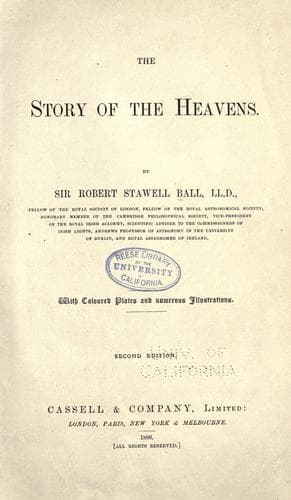
The Story of the HeavensBall, Robert S. (Robert Stawell)
History
The Story of the Heavens
Ball, Robert S. (Robert Stawell)
Astronomy
At length the year 1781 approached, which was to witness his great
achievement. Herschel had made good use of seven years' practical
experience in astronomy, and he had completed a telescope of exquisite
optical perfection, though greatly inferior in size to some of those
which he afterwards erected. With this reflector Herschel commenced a
methodical piece of observation. He formed the scheme of systematically
examining all the stars which were above a certain degree of brightness.
It does not quite appear what object Herschel proposed to himself when
he undertook this labour, but, in any case, he could hardly have
anticipated the extraordinary success with which the work was to be
crowned. In the course of this review the telescope was directed to a
star; that star was examined; then another was brought into the field of
view, and it too was examined. Every star under such circumstances
merely shows itself as a point of light; the point may be brilliant or
not, according as the star is bright or not; the point will also, of
course, show the colour of the star, but it cannot exhibit recognisable
size or shape. The greater, in fact, the perfection of the telescope,
the smaller is the telescopic image of a star.
How many stars Herschel inspected in this review we are not told; but at
all events, on the ever-memorable night of the 13th of March, 1781, he
was pursuing his self-allotted task among the hosts in the constellation
Gemini. Doubtless, one star after another was admitted to view, and was
allowed to pass away. At length, however, an object was placed in the
field which differed from every other star. It was not a mere point of
light; it had a minute, but still a perfectly recognisable, disc. We say
the disc was perfectly recognisable, but we should be careful to add
that it was so in the excellent telescope of Herschel alone. Other
astronomers had seen this object before. Its position had actually been
measured no fewer than nineteen times before the Bath musician, with his
home-made telescope, looked at it, but the previous observers had only
seen it in small meridian instruments with low magnifying powers. Even
after the discovery was made, and when well-trained observers with good
instruments looked again under the direction of Herschel, one after
another bore testimony to the extraordinary delicacy of the great
astronomer's perception, which enabled him almost at the first glance to
discriminate between it and a star.
Public-domain text, read in full here on John Shaqi.
Reviews
Reviews
No reviews yet
Be the first to share your thoughts on this work.
Elsewhere in the archive
Join the Discussion
Join the discussion
Sign in to leave a comment or review.
Sign InorCreate an account