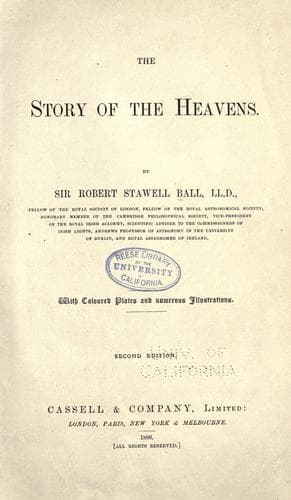
The Story of the HeavensBall, Robert S. (Robert Stawell)
History
The Story of the Heavens
Ball, Robert S. (Robert Stawell)
Astronomy
The measured deviations of Uranus at the different points of its orbit
were the sole data available for the discovery of the new planet. We
have to fit the orbit of the unknown globe, as well as the mass of the
planet itself, in such a way as to account for the various
perturbations. Let us, for instance, assume a certain distance for the
hypothetical body, and try if we can assign both an orbit and a mass for
the planet, at that distance, which shall account for the perturbations.
Our first assumption is perhaps too great. We try again with a lesser
distance. We can now represent the observations with greater accuracy. A
third attempt will give the result still more closely, until at length
the distance of the unknown planet is determined. In a similar way the
mass of the body can be also determined. We assume a certain value, and
calculate the perturbations. If the results seem greater than those
obtained by observations, then the assumed mass is too great. We amend
the assumption, and recompute with a lesser amount, and so on until at
length we determine a mass for the planet which harmonises with the
results of actual measurement. The other elements of the unknown
orbit--its eccentricity and the position of its axis--are all to be
ascertained in a similar manner. At length it appeared that the
perturbations of Uranus could be completely explained if the unknown
planet had a certain mass, and moved in an orbit which had a certain
position, while it was also manifest that no very different orbit or
greatly altered mass would explain the observed facts.
These remarkable computations were undertaken quite independently by two
astronomers--one in England and one in France. Each of them attacked,
and each of them succeeded in solving, the great problem. The scientific
men of England and the scientific men of France joined issue on the
question as to the claims of their respective champions to the great
discovery; but in the forty years which have elapsed since these
memorable researches the question has gradually become settled. It is
the impartial verdict of the scientific world outside England and
France, that the merits of this splendid triumph of science must be
divided equally between the late distinguished Professor J.C. Adams, of
Cambridge, and the late U.J.J. Le Verrier, the director of the Paris
Observatory.
Public-domain text, read in full here on John Shaqi.
Reviews
Reviews
No reviews yet
Be the first to share your thoughts on this work.
Elsewhere in the archive
Join the Discussion
Join the discussion
Sign in to leave a comment or review.
Sign InorCreate an account