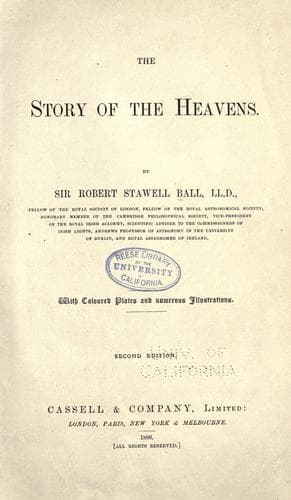
The Story of the HeavensBall, Robert S. (Robert Stawell)
History
The Story of the Heavens
Ball, Robert S. (Robert Stawell)
Astronomy
This prediction was a memorable event in the history of astronomy,
inasmuch as it was the first attempt to foretell the apparition of one
of those mysterious bodies whose visits seemed guided by no fixed law,
and which were usually regarded as omens of awful import. Halley felt
the importance of his announcement. He knew that his earthly course
would have run long before the comet had completed its revolution; and,
in language almost touching, the great astronomer writes: "Wherefore if
it should return according to our prediction about the year 1758,
impartial posterity will not refuse to acknowledge that this was first
discovered by an Englishman."
As the time drew near when this great event was expected, it awakened
the liveliest interest among astronomers. The distinguished
mathematician Clairaut undertook to compute anew, by the aid of improved
methods, the effect which would be wrought on the comet by the
attraction of the planets. His analysis of the perturbations was
sufficient to show that the object would be kept back for 100 days by
Saturn, and for 518 days by Jupiter. He therefore gave some additional
exactness to the prediction of Halley, and finally concluded that this
comet would reach the perihelion, or the point of its path nearest to
the sun, about the middle of April, 1759. The sagacious astronomer (who,
we must remember, lived long before the discovery of Uranus and of
Neptune) further adds that as this body retreats so far, it may possibly
be subject to influences of which we do not know, or to the disturbance
even of some planet too remote to be ever perceived. He, accordingly,
qualified his prediction with the statement that, owing to these unknown
possibilities, his calculations might be a month wrong one way or the
other. Clairaut made this memorable communication to the Academy of
Sciences on the 14th of November, 1758. The attention of astronomers was
immediately quickened to see whether the visitor, who last appeared
seventy-six years previously, was about to return. Night after night the
heavens were scanned. On Christmas Day in 1758 the comet was first
detected, and it passed closest to the sun about midnight on the 12th of
March, just a month earlier than the time announced by Clairaut, but
still within the limits of error which he had assigned as being
possible.
Public-domain text, read in full here on John Shaqi.
Reviews
Reviews
No reviews yet
Be the first to share your thoughts on this work.
Elsewhere in the archive
Join the Discussion
Join the discussion
Sign in to leave a comment or review.
Sign InorCreate an account