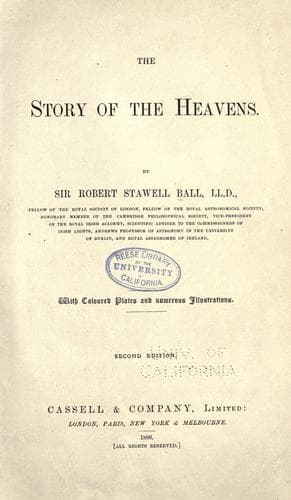
The Story of the HeavensBall, Robert S. (Robert Stawell)
History
The Story of the Heavens
Ball, Robert S. (Robert Stawell)
Astronomy
Though Mercury is one of the smallest of the planets, it is perhaps the
most troublesome to the astronomer. It lies so close to the sun that it
is seen but seldom in comparison with the other great planets. Its orbit
is very eccentric, and it experiences disturbances by the attraction of
other bodies in a way not yet fully understood. A special difficulty has
also been found in the attempt to place Mercury in the weighing scales.
We can weigh the whole earth, we can weigh the sun, the moon, and even
Jupiter and other planets, but Mercury presents difficulties of a
peculiar character. Le Verrier, however, succeeded in devising a method
of weighing it. He demonstrated that our earth is attracted by this
planet, and he showed how the amount of attraction may be disclosed by
observations of the sun, so that, from an examination of the
observations, he made an approximate determination of the mass of
Mercury. Le Verrier's result indicated that the weight of the planet was
about the fourteenth part of the weight of the earth. In other words, if
our earth was placed in a balance, and fourteen globes, each equal to
Mercury, were laid in the other, the scales would hang evenly. It was
necessary that this result should be received with great caution. It
depended upon a delicate interpretation of somewhat precarious
measurements. It could only be regarded as of provisional value, to be
discarded when a better one should be obtained.
The approach of Encke's comet to Mercury, and the elaborate
investigations of Von Asten and Backlund, in which the observations of
the body were discussed, have thrown much light on the subject; but,
owing to a peculiarity in the motion of this comet, which we shall
presently mention, the difficulties of this investigation are enormous.
Backlund's latest result is, that the sun is 9,700,000 times as heavy as
Mercury, and he considers that this is worthy of great confidence. There
is a considerable difference between this result (which makes the earth
about thirty times as heavy as Mercury) and that of Le Verrier; and, on
the other hand, Haerdtl has, from the motion of Winnecke's periodic
comet, found a value of the mass of Mercury which is not very different
from Le Verrier's. Mercury is, however, the only planet about the mass
of which there is any serious uncertainty, and this must not make us
doubt the accuracy of this delicate weighing-machine. Look at the orbit
of Jupiter, to which Encke's comet approaches so nearly when it retreats
from the sun. It will sometimes happen that Jupiter and the comet are in
close proximity, and then the mighty planet seriously disturbs the
pliable orbit of the comet. The path of the latter bears unmistakable
traces of the Jupiter perturbations, as well as of the Mercury
perturbations. It might seem a hopeless task to discriminate between the
influences of the two planets, overshadowed as they both are by the
supreme control of the sun, but contrivances of mathematical analysis
Public-domain text, read in full here on John Shaqi.
Reviews
Reviews
No reviews yet
Be the first to share your thoughts on this work.
Elsewhere in the archive
Join the Discussion
Join the discussion
Sign in to leave a comment or review.
Sign InorCreate an account