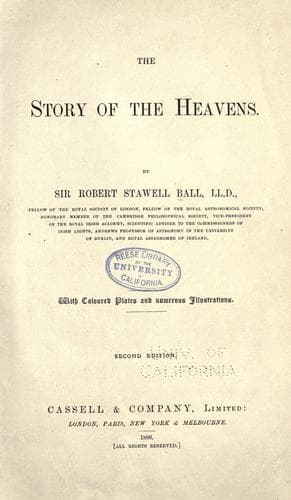
The Story of the HeavensBall, Robert S. (Robert Stawell)
History
The Story of the Heavens
Ball, Robert S. (Robert Stawell)
Astronomy
As comets are much nearer to the earth than the stars, it will
occasionally happen that the comet must arrive at a position directly
between the earth and a star. There is quite a similar phenomenon in the
movement of the moon. A star is frequently occulted in this way, and the
observations of such phenomena are familiar to astronomers; but when a
comet passes in front of a star the circumstances are widely different.
The star is indeed seen nearly as well through the comet as it would be
if the comet were entirely out of the way. This has often been noticed.
One of the most celebrated observations of this kind was made by the
late Sir John Herschel on Biela's comet, which is one of the periodic
class, and will be alluded to in the next chapter. The illustrious
astronomer saw on one occasion this object pass over a star cluster. It
consisted of excessively minute stars, which could only be seen by a
powerful telescope, such as the one Sir John was using. The faintest
haze or the merest trace of a cloud would have sufficed to hide all the
stars. It was therefore with no little interest that the astronomer
watched the progress of Biela's comet. Gradually the wanderer encroached
on the group of stars, so that if it had any appreciable solidity the
numerous twinkling points would have been completely screened. But what
were the facts? Down to the most minute star in that cluster, down to
the smallest point of light which the great telescope could show, every
object in the group was distinctly seen to twinkle right through the
mass of Biela's comet.
This was an important observation. We must recollect that the veil drawn
between the cluster and the telescope was not a thin curtain; it was a
volume of cometary substance many thousands of miles in thickness.
Contrast, then, the almost inconceivable tenuity of a comet with the
clouds to which we are accustomed. A cloud a few hundred feet thick
will hide not only the stars, but even the great sun himself. The
lightest haze that ever floated in a summer sky would do more to screen
the stars from our view than would one hundred thousand miles of such
cometary material as was here interposed.
The great comet of Donati passed over many stars which were visible
distinctly through its tail. Among these stars was a very bright
one--the well-known Arcturus. The comet, fortunately, happened to pass
over Arcturus, and though nearly the densest part of the comet was
interposed between the earth and the star, yet Arcturus twinkled on with
undiminished lustre through the thickness of this stupendous curtain.
Recent observations have, however, shown that stars in some cases
experience change in lustre when the denser part of the comet passes
over them. It is, indeed, difficult to imagine that a star would remain
visible if the nucleus of a really large comet passed over it; but it
does not seem that an opportunity of testing this supposition has yet
arisen.
Public-domain text, read in full here on John Shaqi.
Reviews
Reviews
No reviews yet
Be the first to share your thoughts on this work.
Elsewhere in the archive
Join the Discussion
Join the discussion
Sign in to leave a comment or review.
Sign InorCreate an account