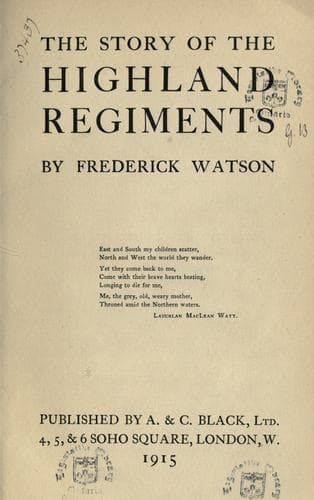
The Story of the Highland RegimentsWatson, Frederick
History
The Story of the Highland Regiments
Watson, Frederick
Great Britain. Army
Whether foolishly or not cannot be discussed here, the British
Government instructed Sir Evelyn Wood to come to terms at all costs, and
the truce that resulted gave the Transvaal into Boer hands, with Mr.
Kruger as President. We see now how unwise it was to permit this
disgrace and humiliation to the British arms and the British name. Long
years of quarrelling between the Boer colonists and those who
acknowledged the sovereignty of England, were to make South Africa a
place of miserable dissension. The easy success over a few hundred
trapped British soldiers was magnified, in the eyes of the more ignorant
Boers, into a victory over the whole English race, and until the Great
War of 1899-1902 no occasion was ever let slip on which the name of
‘Majuba’ could be recalled and emphasised.
CHAPTER XXI
WITH THE HIGHLAND BRIGADE AT TEL-EL-KEBIR
(1882)
Where ha’e ye been a’ the day,
Bonnie laddie, Highland laddie?
Saw ye him that’s far away,
Bonnie laddie, Highland laddie?
On his head a bonnet blue,
Bonnie laddie, Highland laddie;
Tartan plaid and Highland trews,
Bonnie laddie, Highland laddie?
_Regimental March._
Previous to 1882 Egypt had for many years been under the control of
England and France, but neither of these Powers had actually occupied
the country. In 1882, owing to the Nationalist Movement under Arabi Bey,
which endangered the lives and property of Europeans, these two Powers
decided that some steps must be taken to ensure the security of the
white population. Shortly after, France agreed to leave the matter in
the hands of the English, and the British fleet bombarded Arabi’s
position at Alexandria, while the English army under Sir Garnet Wolseley
landed upon the coast to crush the Egyptian forces. This action was to
end in the English occupation of Egypt, which has lasted until to-day.
The principal reason for acting so quickly and with such determination
was the danger that would ensue should the control of the Suez Canal
fall into the hands of a hostile Power. The Khedive, who was a vassal of
the Sultan, possessed at this time a mere shadow of authority, and after
the war an English official was appointed to control his policy.
Sir Garnet Wolseley having decided to give the enemy no warning of his
advance upon Cairo, planned to descend upon the city from Ismailia, and
not from Alexandria as they expected. The position of Tel-el-Kebir was
destined to become the scene of the final battle before the march upon
Cairo.
Public-domain text, read in full here on John Shaqi.
Reviews
Reviews
No reviews yet
Be the first to share your thoughts on this work.
Elsewhere in the archive
Join the Discussion
Join the discussion
Sign in to leave a comment or review.
Sign InorCreate an account