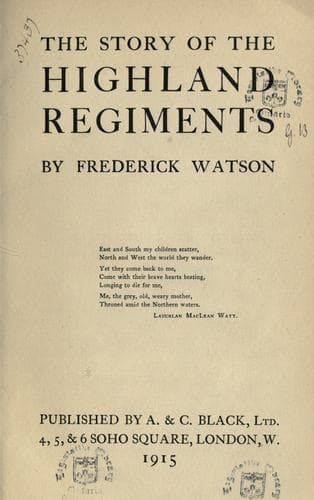
The Story of the Highland RegimentsWatson, Frederick
History
The Story of the Highland Regiments
Watson, Frederick
Great Britain. Army
About an hour before sunrise the Highlanders found themselves beneath
the parapet of the enemy’s position, and the end of the hazardous march
was reached. Sir Archibald Alison, who commanded the Highland Brigade,
has written: “The Brigade formed for the march in the order in which it
was to attack—two lines two deep. The rifles were unloaded, the bayonets
unfixed, and the men warned that only two signals would be given—a word
to ‘Fix bayonets,’ a bugle sound of ‘To storm.’ I never felt anything so
solemn as that night march, nor do I believe that any one who was in it
will ever forget it. No light but a faint star; no sound but the slow,
measured tread of men on the desert sand. Just as the first tinge of
light appeared in the east a few rifle shots fired out of the darkness
showed that the enemy’s outposts were reached. The sharp click of the
bayonets then answered the word, ‘To fix’—a few minutes more of deep
silence, and then a blaze of musketry flashed across our front, and
passed far away to each flank, by the light of which we saw the swarthy
faces of the Egyptians, surmounted by their red tarbooshes, lining the
dark rampart before us. I never felt such a relief in my life. I knew
then that Wolseley’s star was bright, that the dangerous zone of fire
had been passed in the darkness, that all had come now to depend upon a
hand-to-hand struggle.”
The Highlanders were some hundred and fifty yards from the Egyptian
entrenchments, which were 6 feet high and 4 feet deep. Suddenly through
the long night silence a bugle rang out, and with a cheer the Highland
Brigade broke into a charge. Some 200 men fell before they reached the
parapet, the losses being increased before they scaled the
entrenchments. Alison had written that he never saw men fight more
steadily than the Egyptian soldiers, they rallied every foot of the way.
“At this time,” he says, “it was a noble sight to see the Gordon and
Cameron Highlanders—now mingled together in the confusion of the fight,
their young officers leading with waving swords, their pipes screaming,
and that proud smile on the lips and that bright gleam in the eyes of
the men which you see only in the hour of successful battle.”
It is said Donald Cameron of the Camerons was “the first man to mount
the trenches, and the second man to fall.” A minute, and whole companies
of men were swarming and pouring like waves of the sea over the Egyptian
defences, and rushing down upon their defenders. Although taken by
surprise the enemy made a stubborn fight, but after half an hour’s
fierce conflict the battle of Tel-el-Kebir was over, and the morning sun
rose to pour its rays down upon the flying Egyptian army. Without delay
Sir Garnet Wolseley pushed forward the cavalry to advance upon Cairo.
Thus Arabi was prevented either from arresting the retreat or sacking
the city, and realising that there was no further hope in resistance to
the British arms he surrendered his sword, and the rebellion was over.
Public-domain text, read in full here on John Shaqi.
Reviews
Reviews
No reviews yet
Be the first to share your thoughts on this work.
Elsewhere in the archive
Join the Discussion
Join the discussion
Sign in to leave a comment or review.
Sign InorCreate an account