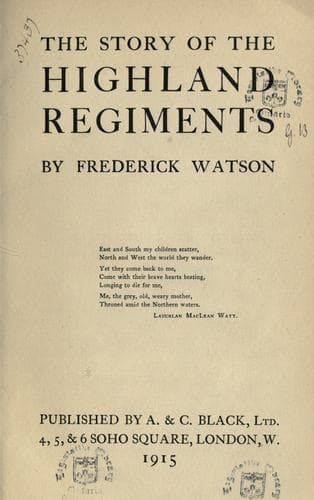
The Story of the Highland RegimentsWatson, Frederick
History
The Story of the Highland Regiments
Watson, Frederick
Great Britain. Army
For a moment it seemed as though Baker’s disaster was to be repeated.
But the British regulars were very unlike the undisciplined Egyptians.
“The spectacle,” wrote a war correspondent, “did not so much terrify as
exercise a weird, terrible fascination. I do not suppose that either I
or any one else who witnessed it will often again see its equal for
magnificence. Though retreating, our men literally mowed down their
assailants. In the smoke and dust of the battle, amid the bright gleam
of their myriad spearheads, the semi-nude, brown-skinned, black,
shaggy-haired warriors were falling down in scores. Of all the savage
races of the world none are more desperately brave than the Soudan
Arabs, who were breaking upon our ranks like a tempestuous sea. At last
the pressure of the front upon the rear became so great that those of us
who were mounted were for a few moments too tightly wedged together to
be able to move; but we felt the collapse was only temporary.”
It was touch and go, but the undismayed veterans of the Black Watch and
those other troops who formed the British force were bound, sooner or
later, to enforce their superiority. Presently, shoulder to shoulder,
forming where they could into squares, the 42nd and 65th began to
advance. For a moment the conflict was in suspense, then the crisis had
passed. The victory was won.
Unhappily, the British Government took no advantage of Graham’s
successes, and decided upon the evacuation of the Soudan. Under these
circumstances the only thing left to do was to ensure the safety of the
civilians in the various towns more or less under European control.
There was one man above all others who was competent to deal with the
exigencies of the situation, and that was General Gordon. He was begged
by the Government to leave for Egypt to carry out this mission. We must
not overlook, in justice to the Government, that neither they nor
probably Gordon himself appreciated the strength of the revolutionary
movement in the Soudan, so that when he arrived at Khartoum in February
1884 he was dismayed to find it was exceedingly likely that he would be
isolated there, if not actually besieged by the enemy. Accordingly, he
advised the Government to make good the advantage gained by Sir Gerald
Graham, and ensure a lasting peace in the Soudan. But the Government
refused to be interested in the problem. Then Gordon communicated with
the country, stating that he had provisions for only five months. Lord
Granville, without dealing with the situation in any way, instructed him
to leave Khartoum as best he could, and it was not until the end of
March that the grave danger to Gordon was realised. Lord Wolseley,
voicing the sympathies of the English people, begged the Government to
do something to save a man whom they had sent out to represent the
country.
Public-domain text, read in full here on John Shaqi.
Reviews
Reviews
No reviews yet
Be the first to share your thoughts on this work.
Elsewhere in the archive
Join the Discussion
Join the discussion
Sign in to leave a comment or review.
Sign InorCreate an account