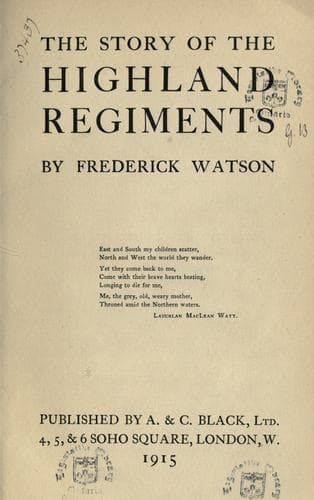
The Story of the Highland RegimentsWatson, Frederick
History
The Story of the Highland Regiments
Watson, Frederick
Great Britain. Army
The failure of the Gordon Relief Expedition encouraged the Mahdi in the
belief that his success was due to the direct guidance of God. In his
own mind, at least, he had driven the British home again, and although
his death occurred in 1885, it in no way concluded the threatening of
Egypt. There were many contests between the Dervishes and the Egyptian
troops, who, led by British officers, were now able to hold their own.
The labours of Kitchener were already beginning to bear fruit.
In August 1886 he was appointed Governor of Suakin, and instantly set
about fortifying the place against the Dervishes. Various engagements
followed during the forthcoming years, and the struggle with the Mahdi’s
forces went on until the campaign opened which was to end in the final
and crushing victory of Omdurman. It must not be thought that this
success was simply a success of arms; there had been many of those in
the past. It was rather the culminating and final achievement in a long
and silent campaign extending over many years, opening, as we have seen,
with the first rather dismal efforts at training the Egyptians, passing
on to that wonderful system of railways which crossed over five hundred
miles of bare desert, to reach its appointed end in the fall of Omdurman
and Mahdism.
It had taken sixteen years to make the Anglo-Egyptian army, and by the
time the battle of Omdurman was fought it numbered 18,000 men, with 140
English officers.
From 1888 to 1892 Kitchener was Adjutant-General of the Egyptian Army;
in 1892 he became Sirdar. At last, in 1894, he seized his opportunity.
There was at this time a new Khedive—a young man who showed signs of
resisting or criticising British rule. Without hesitation the Sirdar
showed him very clearly that this would be unwise behaviour. He followed
up his action by pushing forward his railways, mile by mile, towards
Omdurman, the city of the Khalifa. It was impossible for the latter to
surrender the city, for such an action would proclaim throughout the
Soudan that the Mahdi was little better than a fugitive. The dawn of
peace was already breaking. Omdurman was within striking distance.
The Dongola Expedition took place in 1896, resulting in the capture of
Dongola and the dispersal of the Arabs in that quarter. In 1897 the
Government at last came to a practical decision, and determined to crush
for ever the power of the Khalifa, and for that purpose despatched an
army in which were included the Seaforth Highlanders and the Camerons.
It was no unexpected event for Kitchener. More truly was it the last
mile of the journey. His organisation was complete, his troops were
efficient, he could take his own time, and the result was certain.
Public-domain text, read in full here on John Shaqi.
Reviews
Reviews
No reviews yet
Be the first to share your thoughts on this work.
Elsewhere in the archive
Join the Discussion
Join the discussion
Sign in to leave a comment or review.
Sign InorCreate an account