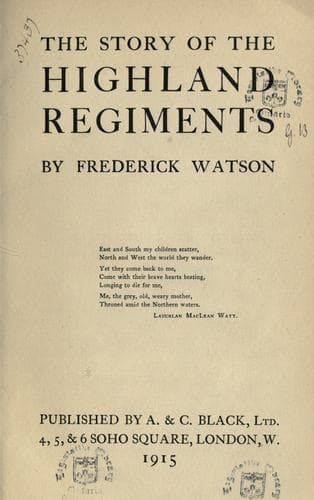
The Story of the Highland RegimentsWatson, Frederick
History
The Story of the Highland Regiments
Watson, Frederick
Great Britain. Army
The fire of the Dervishes from their trenches rained thick and fast upon
the Highlanders as they came through the break in the hedges, but when
they had gained a real foothold inside the zeriba, the Dervishes lost
heart, and made away towards the Atbara River. The fine strategy of
Kitchener forcing an engagement at this point was now apparent. The
enemy were faced with thirty miles of waterless desert, at the end of
which it was probable they would encounter the British gunboats. It was
more than a victory in arms; it struck the first devastating blow at the
power of the Khalifa.
In answer to Kitchener’s despatch, Queen Victoria replied: “Anxious to
know how the wounded British and Egyptians are going on. Am proud of the
gallantry of my soldiers. So glad my Cameron Highlanders should have
been amongst them.”
A writer in _Blackwood’s Magazine_ relates the following striking
incident, doubly pregnant with meaning to-day. “After Atbara,” he says,
“and as we rode through the ‘dem,’ Lord Cecil joined us, and presently
K. pulled up among the charred corpses on the burning ground to make
some enquiries. Cecil made a grimace and pointed to the ground; it was
strewn with Dervish shells lying about under our horses’ hoofs and the
hoofs of the chief’s horse, with the grass on fire all around them.
Neither of us spoke, but Kismet, destiny, or whatever it is that sits
behind the crupper, impelled K. to move on, and a few minutes later a
column of smoke shot up into the air—the shells had exploded. But K. had
passed on—destiny had need of him still.”
In July 1898 began the advance on Omdurman, in which the Camerons and
Seaforths took part. The battle was fought on September 2nd. The
Khalifa’s army numbered some 50,000 men, and the fight that was to end
in the utter defeat of Mahdism extended over five hours. The Highlanders
did not take as prominent a part here as at Atbara, and the chief battle
honours lie with Brigadier-General Hector Macdonald, whose Soudanese
troops were handled with much brilliancy, and the 21st Lancers, the
glory of whose charge rang throughout England and the Empire.
The Dervishes, trusting to their overwhelming superiority in numbers,
advanced in dense hordes against the British lines, and at this point of
the engagement the Camerons and Seaforths withstood the fury of the
opening attack with magnificent steadiness. The enemy were met with a
murderous fire; whole lines and ranks were simply mown down by our
shrapnel: attack upon attack was launched with reckless gallantry,
always to be repulsed.
Public-domain text, read in full here on John Shaqi.
Reviews
Reviews
No reviews yet
Be the first to share your thoughts on this work.
Elsewhere in the archive
Join the Discussion
Join the discussion
Sign in to leave a comment or review.
Sign InorCreate an account