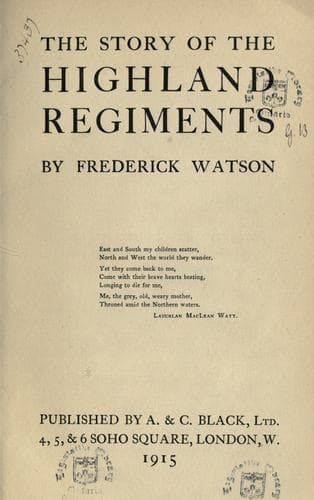
The Story of the Highland RegimentsWatson, Frederick
History
The Story of the Highland Regiments
Watson, Frederick
Great Britain. Army
The Sikhs set out on this perilous business, while the Gordons marched
up the centre of the Pass, and then, cutting away to the right, set
their faces to the hill-side. They provided an easy mark for the enemy,
but the advance was never checked, and when the ridge was reached a
hand-to-hand conflict took place. Once on top the Gordons and the
Scottish Borderers soon cleared the enemy out of the position. The
Gordons and the Gurkhas were then left to defend the famous Malakand
Pass, while General Low pushed on after the enemy. By dogged
perseverance and the efficiency of the artillery the British were
enabled to fight their way through to Chitral, and on April 20 marched
into the town. Umra Khan made for Afghanistan, and the campaign was
ended. A fort was built in case of further revolution, and that greatest
of all factors in civilisation—a road—was constructed to unite India
with this outlying post.
Naturally enough, the tribes who were in the neighbourhood of Chitral,
and whose country lay between it and India, were by no means pleased by
the occupation by British troops, nor did they take very kindly to the
road which meant to them their eventual subjection. For a considerable
time there were rumours of trouble, and in the end there broke out a
sudden rising of the people in the Waziri country. This was in 1897, and
so widespread was the trouble that it was not crushed until the Indian
Government had put under arms the most formidable force since the
Mutiny.
There are several factors in such tribal uprisings that carry with them
their ultimate defeat. First of all, there are always rumours of revolt
before it actually bursts into flame; secondly, the tribes find it
difficult to unite together, or even to rise at the same time—thus a
disciplined army can deal with one after another; thirdly, they have no
definite system of organisation, and—as in the case of the Afghans—are
little better than an army of snipers.
The Waziris rose first, then the Swatis under the Mad Mullah, and so on
to the Afridis and the Orakzais. Each of these tribes was capable of
putting a great many men in the field. It has been stated that the
Afridis alone could provide 30,000 men armed with modern rifles. Sir
William Lockhart with 34,000 men, including some 12,000 British troops,
amongst whom were the 1st Battalion of the Gordon Highlanders, was sent
against these Afridis. In accordance with the native custom of warfare,
the enemy took up a position at the summit of the now celebrated ridge
of Dargai, and there awaited the arrival of the British. To advance with
any safety, this pass must first of all be cleared.
Public-domain text, read in full here on John Shaqi.
Reviews
Reviews
No reviews yet
Be the first to share your thoughts on this work.
Elsewhere in the archive
Join the Discussion
Join the discussion
Sign in to leave a comment or review.
Sign InorCreate an account