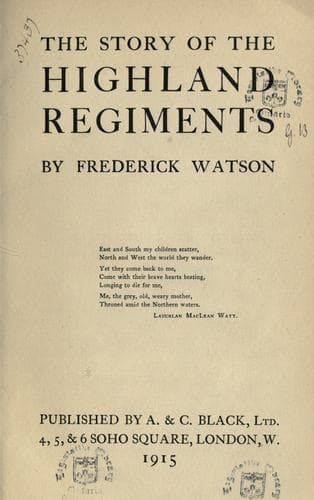
The Story of the Highland RegimentsWatson, Frederick
History
The Story of the Highland Regiments
Watson, Frederick
Great Britain. Army
carried out of further danger by Private Lawson. The first division
reach the sheltering rocks, panting for breath; they shout, the officers
waving their swords to those behind; while Piper Findlater, though
wounded and unable to move, still inspires them with his warlike
strains. They start again, ‘the men cheering like mad,’ up the
precipitous path leading to the crest where they look for a warm
reception. But the top is reached—it forms a succession of ridges along
which the Highlanders rush unopposed, and great is the cheering as they
realise that the enemy is in full flight.”
To put it bluntly, the Afridis had not waited to dispute the position
with men who could not be stopped by bullets, and this charge in the
face of such a deadly and concentrated fire will be long considered as
courageous and splendid a story as anything in the history of the
Highland regiments. What followed can be told in very few lines. The war
against the Afridis was by no means over, but the eventual issue was
already in sight. The advance through the almost impenetrable ravines
and over the rugged hills progressed painfully, but with determination.
Peace came on April 4, 1898. It had been a memorable campaign, and one
that the troops engaged in were naturally proud to commemorate. As Sir
William Lockhart said in taking leave of them, “The boast of the tribes
was that no foreign army—Moghul, Afghan, Persian, or British—had ever
penetrated, or could penetrate their country; but after carrying three
strong positions and being for weeks subsequently engaged in daily
skirmishes, the troops succeeded in visiting every portion of Tirah, a
fact which will be kept alive in the minds of future generations by
ruined forts and towers in their remotest valleys.”
The Gordons received two Victoria Crosses for gallantry in the action at
Dargai, and established themselves, by their exploit, first favourites
in the affections of the British people.
CHAPTER XXIV
FROM THE BEGINNING OF THE BOER WAR TO THE BATTLE OF MODDER RIVER
(1899)
“She stands alone: ally nor friend has she,”
Saith Europe of our England—her who bore
Drake, Blake, and Nelson—Warrior-Queen who wore
Light’s conquering glaive that strikes the conquered free.
Alone?—From Canada comes o’er the sea,
And from that English coast with coral shore,
The old-world cry Europe hath heard of yore
From Dover cliffs: “Ready, aye ready we!”
“Europe,” saith England, “hath forgot my boys!—
Forgot how tall, in yonder golden zone
‘Neath Austral skies, my youngest born have grown
(Bearers of bayonets now and swords for toys)—
Forgot ‘mid boltless thunder—harmless noise—
The sons with whom old England ‘stands alone’!”
THEODORE WATTS-DUNTON.
Public-domain text, read in full here on John Shaqi.
Reviews
Reviews
No reviews yet
Be the first to share your thoughts on this work.
Elsewhere in the archive
Join the Discussion
Join the discussion
Sign in to leave a comment or review.
Sign InorCreate an account