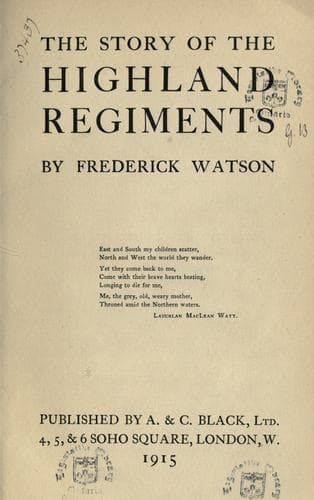
The Story of the Highland RegimentsWatson, Frederick
History
The Story of the Highland Regiments
Watson, Frederick
Great Britain. Army
“The night march was ordered for 12.30 A.M., the bearings and distance
having been ascertained at great personal risk by Major Benson, Royal
Artillery, my Deputy-Assistant-Adjutant-General. The distance is two and
a half miles, and daybreak was due at 3.25 A.M. I may remark that two
rifles went off by accident before the march commenced, and it is pretty
clear flashes from a lantern gave the enemy timely notice of the march.
Before moving off, Major-General Wauchope explained all he intended to
do, and the particular part each battalion of his brigade was to play in
the scheme, namely, that he intended to march direct on the south-west
spur of the kopje, and on arrival near the objective before daybreak the
Black Watch were to move to the east of the kopje, where he believed the
enemy to be posted under shelter, whilst the Seaforth Highlanders were
to march straight to the south-east point of the kopje, with the Argyll
and Sutherland Highlanders prolonging the line to the left, the Highland
Infantry to be in reserve until the action was developed. The Brigade
was to march in mass of quarter column, the four battalions keeping
touch, and if necessary ropes were to be used for the left guides. These
ropes were taken, but, I believe, used by only two battalions. The three
battalions were to extend just before daybreak—two companies in firing
line, two companies in support, and four companies in reserve—all at
five paces interval between them.”
It is not our business to criticise the scheme of attack, but only to
deplore the fact that so many brave men should lose their lives in such
an abortive attempt. It would have been impossible to reach the Boer
lines in anything but disorder had the Highland Brigade not advanced in
close column: the blunder appears to have been that they maintained
close formation too long. Long before, in the year 1746, the
Highlanders, who might be expected to have an intimate knowledge of the
country through which they were passing, set out upon a similar night
attack, only to find themselves hopelessly lost—and that not so very far
from Inverness. At Magersfontein the distance was a short one, but the
difficulty of ascertaining how far the Boer trenches were from the
foremost columns led to chaos. No one has described the situation more
graphically than Sir Arthur Conan Doyle in _The Great Boer War_. “With
many a trip and stumble,” he writes, “the ill-fated detachment wandered
on, uncertain where they were going and uncertain what it was they were
meant to do. Not only among the rank and file, but among the principal
officers there was the same absolute ignorance. Brigadier Wauchope knew,
no doubt, but his voice was soon to be stilled in death. The others were
aware, of course, that they were advancing either to turn the enemy’s
trenches or to attack them, but they may well have argued from their own
formation that they could not be near the riflemen yet. Why they should
Public-domain text, read in full here on John Shaqi.
Reviews
Reviews
No reviews yet
Be the first to share your thoughts on this work.
Elsewhere in the archive
Join the Discussion
Join the discussion
Sign in to leave a comment or review.
Sign InorCreate an account