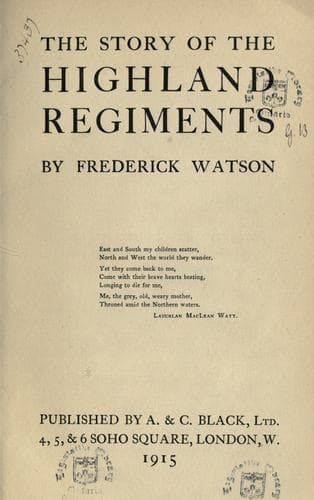
The Story of the Highland RegimentsWatson, Frederick
History
The Story of the Highland Regiments
Watson, Frederick
Great Britain. Army
The action continued all day, and eventually, on the approach of the 9th
Lancers, the Boers fell back and the Highland Brigade returned to the
Modder River, having lost some fifty men. There followed afterwards the
relief of Kimberley, and from thence onwards to the end of the war the
part taken by the Highlanders was peculiarly arduous and without many
distinguished features. Month after month they were employed in hard
marching, holding positions that the mounted troops had carried,
uncomplaining as always, and winning back here and there some of the
losses that they had suffered at the hands of the enemy at
Magersfontein. We have seen how the Gordons were instrumental in the
capture of Cronje, despite the heavy fire with which they were met from
the Boer trenches, and it is a notable fact that the Highland Brigade,
for all their handling at Magersfontein, appear to have suffered in no
way in prestige, and were only too anxious to make good. “On the 18th,”
says General Colville, speaking of the end of Cronje, “the courage and
determination shown by the Highland Brigade in their advance over some
fifteen hundred yards of perfectly open plain, and their passage of the
river, both under heavy fire, are beyond all praise.”
CHAPTER XXVII
WITH SIR IAN HAMILTON TO PRETORIA
(1900)
To you who know the face of war,
You, that for England wander far,
You that have seen the Ghazis fly
From English lads not sworn to die,
You that have lain, where, deadly chill,
The mist crept o’er the Shameful Hill,
You that have conquered, mile by mile,
The currents of unfriendly Nile,
And cheered the march, and eased the strain
When Politics made valour vain,
Ian, to you from banks of Ken,
We send our lays of Englishmen!
ANDREW LANG.
It was during the halt at Bloemfontein that the Highland Brigade
received reinforcements from home, and no praise could be too high for
the volunteers who formed additional companies to the regiments of the
regular forces. To-day, when thousands and hundreds of thousands are
trained soldiers who a year ago had never held a rifle in their hands,
it would be futile to belaud the qualities of the amateur soldier. But
until the Boer War no one had taken unprofessional soldiers very
seriously. Just as the Territorials won the esteem of the Regulars in
Flanders, so the companies of Volunteers earned the admiration and
gratitude of the country in the Boer War.
Public-domain text, read in full here on John Shaqi.
Reviews
Reviews
No reviews yet
Be the first to share your thoughts on this work.
Elsewhere in the archive
Join the Discussion
Join the discussion
Sign in to leave a comment or review.
Sign InorCreate an account