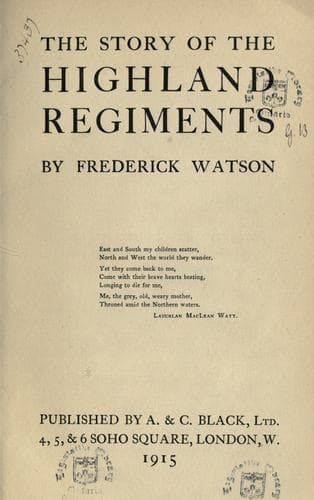
The Story of the Highland RegimentsWatson, Frederick
History
The Story of the Highland Regiments
Watson, Frederick
Great Britain. Army
The Boers were never able to tolerate that kind of advance, and finding
that rifles would not stop the Highlanders, they hastily retreated, and
soon afterwards General Ian Hamilton rode over to congratulate the
battalion on their exploit. Lord Roberts was not long in sending his
praise. “Tell the Gordons,” he wrote, “that I am proud to think that I
have a Highlander as one of the supporters of my coat-of-arms.”
During this action the fourth Victoria Cross was given to the Gordons,
being awarded to Corporal Mackay, who “repeatedly rushed forward under a
withering fire at short range to attend to wounded comrades, dressing
the wounds, while he himself was without shelter, and in one instance
carrying a wounded man from the open under a heavy fire to the shelter
of a boulder.”
On May 31 the Union Jack flew over Johannesburg. At this point General
French arrived, and as senior officer took command. General Sir Ian
Hamilton then thanked the Gordons, “the, regiment my father commanded
and I was born in,” for their support. On June 3 the army set out for
Pretoria, when suddenly the whole contemplated resistance of the Boers
faded away like smoke. President Kruger, not forgetting two millions of
money, but leaving his wife instead, hurried to Delagoa Bay, and with
his departure came the unconditional surrender of Pretoria. It had been
a long and arduous march, covering forty-five days and some four hundred
miles of country. The Highlanders engaged in nine actions, and occupied
five towns. It must have been a dramatic and inspiring spectacle to see
the Gordons and the Camerons, gaunt and lean with all the fatigue
through which they had passed, in tattered clothes and soleless boots,
marching into the Boer capital. It might have been thought that the fall
of Pretoria would have brought with it the conclusion of the Boer War.
But the fall of Pretoria held no special significance to the Boers. Many
of them had probably never seen the town, and took no interest in it.
They resorted to a manner of warfare peculiarly suited to their habits
of life, and which, developing over an extensive country, threatened a
hopeless stalemate. They hoped by a guerilla warfare to weary the
British forces into a favourable peace. From this point to the end of
the war that agile leader De Wet was to make his name familiar as a kind
of military will-o’-the-wisp.
Every week brought with it news of some minor engagement in some
isolated part of the country. Here a position had been attacked or there
a convoy had been seized. Often it was a raid on the long line of
railway running from Capetown to Pretoria, but always De Wet, despite
the efforts of the British, would manage to elude capture and fling his
burghers upon another part of our lines.
Public-domain text, read in full here on John Shaqi.
Reviews
Reviews
No reviews yet
Be the first to share your thoughts on this work.
Elsewhere in the archive
Join the Discussion
Join the discussion
Sign in to leave a comment or review.
Sign InorCreate an account