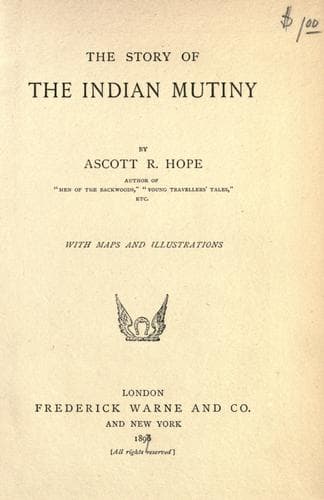
The Story of the Indian MutinyMoncrieff, A. R. Hope (Ascott Robert Hope)
History
The Story of the Indian Mutiny
Moncrieff, A. R. Hope (Ascott Robert Hope)
India -- History -- Sepoy Rebellion, 1857-1858
On November 1, he was at Allahabad, from which his troops were already
pushing on towards Cawnpore, not without an encounter, where the Naval
Brigade won their first laurels on land. Two days later, Sir Colin
reached Cawnpore, and at once had to make a choice of urgent tasks.
To his left, the state of Central India had become threatening. The
revolted Gwalior Contingent Sepoys, in the service of Scindia, had
long been kept inactive by their nominal master; but after the fall of
Delhi, they marched against us under Tantia Topee, the Mahratta chief
who had carried out the massacre at Cawnpore, and now comes forward as
one of the chief generals on the native side. This army, swollen by
bands from Delhi, approached to menace the English communications on
the Ganges, if it were not faced before our men turned to the right for
the relief of Lucknow. The question was, whether or not to deal with
Tantia Topee at once. But Sir Colin, misled like Havelock by a false
estimate of the provisions in the Residency, decided at all risks to
lose no time in carrying off the garrison there, even though he must
leave a powerful enemy in his rear. Over and over again in this war,
English generals had to neglect the most established rules of strategy,
trusting to the ignorance or the cowardice of their opponents. Yet
Tantia Topee showed himself a leader who could by no means be trusted
for failing to improve his opportunities.
Leaving behind him, then, five hundred Europeans and a body of Madras
Sepoys, under General Windham, to hold the passage of the Ganges at
Cawnpore, the Commander-in-Chief marched northwards to join Sir Hope
Grant, awaiting him with a column released from Delhi; and the combined
force moved upon the Alum Bagh, still held by a detachment of Outram's
force. From this point they were able to communicate with the Residency
by means of a semaphore telegraph erected on its roof, worked according
to the instructions of the _Penny Cyclopædia_, which happened to be in
the hands of the besieged. Native messengers also passed to and fro,
through whom Outram had generously recommended the relieving army to
attack Tantia Topee first, letting his garrison hold out upon reduced
rations, as he thought they could do till the end of November. He
had thus furnished Sir Colin with plans of the city and directions
that would be most useful to the latter as a stranger. But it seemed
important to give him some guide fully to be trusted for more precise
information as to the localities through which he must make his attack.
A bold civilian, named Kavanagh, volunteered to go from the Residency
to the camp, on this dangerous errand, by which he well-earned the
Victoria Cross.
Public-domain text, read in full here on John Shaqi.
Reviews
Reviews
No reviews yet
Be the first to share your thoughts on this work.
Elsewhere in the archive
Join the Discussion
Join the discussion
Sign in to leave a comment or review.
Sign InorCreate an account