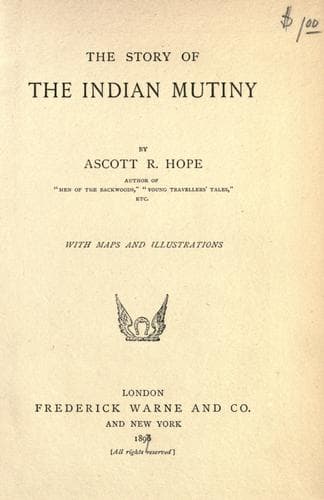
The Story of the Indian MutinyMoncrieff, A. R. Hope (Ascott Robert Hope)
History
The Story of the Indian Mutiny
Moncrieff, A. R. Hope (Ascott Robert Hope)
India -- History -- Sepoy Rebellion, 1857-1858
The advance was now resumed across a plain dotted by houses and
gardens, where soon it came once more to a stand before the Shah
Nujeef, a mosque surrounded with high loop-holed walls, that proved a
harder nut to crack than the Secunder Bagh. For hours it was battered
and assaulted in vain, the General himself leading his Highlanders to
the charge. In vain the guns of Peel's Naval Brigade were once brought
up within a few yards of the walls, worked as resolutely as if their
commander had been laying his ship beside an enemy's. In vain brave
men rushed to their death at those fiery loop-holes, while behind
them reigned a scene of perilous confusion, the soldiers able neither
to advance nor retreat among blazing buildings and deadly missiles.
The narrow road had become choked up by the train of camels and other
animals, so that ammunition could scarcely be forced to the front. From
the opposite side of the river, the enemy brought a heavy gun to bear
upon the disordered ranks. Our batteries had to be withdrawn under
cover of a searching rocket-fire.
For a moment Sir Colin feared all might be lost. Yet, after all, what
seems little better than an accident put an easy end to this desperate
contest. At nightfall, a sergeant of the 93rd, prowling round the
obstinate wall, discovered a fissure through which the Highlanders tore
their way, to see the white-clad Sepoys flitting out through the smoke
before them. Our men could now lie down on their arms, happy to think
that the worst part of the task was over.
Next morning, the same laborious and deadly work went on. Other large
buildings had to be hastily bombarded and a way broken through them,
in presence of a host strong enough to surround the scanty force.
But this day the amazed enemy seemed to have his hands too full to
interfere much with our progress. Parties had been thrown out towards
the city, on Sir Colin's left, to form a chain of posts which should
cover his advance and secure his retreat. Meanwhile, also, the garrison
of the Residency were busy on their side, with mines and sorties,
pushing forward to meet the relieving army, who spent most of the day
in breaching a building known as the Mess House. This was at length
carried, as well as a palace beyond, called the Motee Mahal, by gallant
assaults, foremost in which were two of our most illustrious living
soldiers, Lord Wolseley and Sir Frederick Roberts.
Between the relievers and the defences of the Residency there now
remained only a few hundred yards of open space, swept by the guns of
the Kaiser Bagh. Mr. Kavanagh appears to have been the first man who
reached the garrison with his good news; then Outram and Havelock rode
forward under hot fire to meet Sir Colin Campbell on that hard won
battle-field, over which for days they had been anxiously tracing his
slow progress.
Public-domain text, read in full here on John Shaqi.
Reviews
Reviews
No reviews yet
Be the first to share your thoughts on this work.
Elsewhere in the archive
Join the Discussion
Join the discussion
Sign in to leave a comment or review.
Sign InorCreate an account