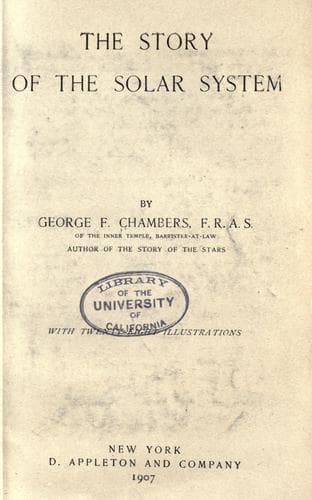
The Story of the Solar SystemChambers, George F. (George Frederick)
Science
The Story of the Solar System
Chambers, George F. (George Frederick)
Solar system
Passing over the great comet of 1861, on which I have already said a
good deal, I must quit the subject of famous comets by a few words about
that of 1882, which, though by no means one of the largest, was, in some
respects, one of the most remarkable of modern times. It was visible for
the long period of nine months, and was conspicuously prominent to the
naked eye during September, but these facts, though note-worthy, would
not have called for particular remark, had not the comet exhibited some
special peculiarities which distinguished it from all others. In the
first place, it seems to have undergone certain disruptive changes, in
virtue of which the nucleus became split up into four independent
nuclei. Then the tail may have been tubular, its extremity being not
only bifid, but totally unsymmetrical with respect to the main part. The
tubular character of the tail was suggested by Tempel. To other
observers, this feature gave the idea of the comet, properly so-called,
being enclosed in a cylindrical envelope, which completely surrounded
the comet, and overlapped it for a considerable distance at both ends.
Finally (and in this resembling Biela’s comet) the comet of 1882 seems
to have thrown off a fragment which became an independent body.
What has gone before, will, I think, have served abundantly to establish
the position with which I started, namely, that comets occupy (and
deservedly so) the front rank amongst those astronomical objects in
which, on occasions, the general public takes an interest.
I have thus completed, so far as the space at my disposal has permitted,
a popular descriptive Survey of the Solar System. Those who have perused
the preceding pages, however slight may have been their previous
acquaintance with the Science of Astronomy taken as a whole, will have
no difficulty in realising that what I have said bears but a small
proportion to what I have left unsaid. They will equally, I hope, be
able to see, without indeed the necessity of a suggestion, that all
those wondrous orbs which we call the planets could neither have come
into existence nor have been maintained in their allotted places for so
many thousands of years, except as the result of Design emanating from
an All-powerful Creator.
FOOTNOTES.
[1]The remark in the text applies to all the major planets and to a
large number of the minor planets, but certain of the minor planets
travel in orbits which are considerably inclined to the ecliptic,
and therefore to all the other planets.
[2]Given in full in my _Handbook of Astronomy_, 4th ed., vol. i., p. 26.
[3]“_Recollections of Past Life_,” 2nd ed., p. 305.
[4]For some information respecting these Secchi “Types” of Stars, see my
“_Story of the Stars_,” 2nd ed., p. 140.
[5]The circle and the ellipse are what are called “closed” curves.
Public-domain text, read in full here on John Shaqi.
Reviews
Reviews
No reviews yet
Be the first to share your thoughts on this work.
Elsewhere in the archive
Join the Discussion
Join the discussion
Sign in to leave a comment or review.
Sign InorCreate an account