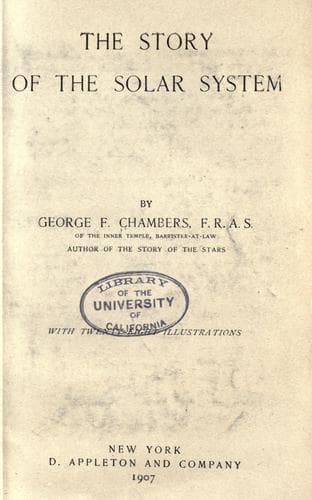
The Story of the Solar SystemChambers, George F. (George Frederick)
Science
The Story of the Solar System
Chambers, George F. (George Frederick)
Solar system
The one special feature of the Moon, which never fails to attract the
attention of everybody who looks at our satellite for the first time
through a telescope, are the crater mountains, which indeed constitute
an immense majority of all the lunar mountains. Their outline almost
always conforms, more or less, to that of the circle, but when seen near
either limb of the Moon they often appear considerably oval simply
because they are then seen considerably foreshortened. In their normal
form they exhibit a basin bounded by a ridge, with a conical elevation
in the centre of the basin, the basin and the cone together being
evidently the result of an uprush of gases breaking through the outer
crust of the Moon and carrying with them masses of molten lava. This
lava, with perhaps the materials in fragments, projected in the first
instance up into the air, fell back on to the Moon forming first of all
the outer edge of the basin, and subsequently, as the eruptive force
became weakened, the small central accumulation, which took, as it
naturally would do, a conical shape. An experimental imitation of the
process thus inferred was carried out some years ago by a French
physicist, Bergeron, who acted upon a very fusible mixture of metals
known as Wood’s alloy by forcing through it a current of hot air. The
success of this experiment was complete, and Bergeron considered that
his experiments, taken as a whole, were calculated to throw much light
on the past history of the Moon.
Several observers at various times have fancied they have seen signs
that the lunar mountain Aristarchus was an active volcano even up to the
present century; but it admits of no doubt that this idea is altogether
a misconception, and that what they saw as a faint illumination of the
summit of Aristarchus was no more than an effect of earth-shine. On the
general question of volcanic action on the Moon, Sir John Herschel
summed up as follows:—“Decisive marks of volcanic stratification arising
from successive deposits of ejected matter, and evident indications of
lava currents, streaming outwards in all directions, may be clearly
traced with powerful telescopes. In Lord Rosse’s magnificent Reflector
the flat bottom of the crater called Albategnius is seen to be strewed
with blocks not visible in inferior telescopes, while the exterior ridge
of another (Aristillus) is all hatched over with deep gulleys radiating
towards its centre.”
The valleys and clefts or rills visible on the Moon’s surface constitute
another remarkable feature in the topography of our satellite. The
valleys, properly so-called, require no particular comment, because they
are just what their name implies—hollows often many miles long and
several miles wide. The clefts or rills, however, are more mysterious,
by reason of their great length and remarkable narrowness. One is almost
led to infer that they are naught else but cracks in the lunar crust,
the result of sudden cooling, how caused is of course not known.
Public-domain text, read in full here on John Shaqi.
Reviews
Reviews
No reviews yet
Be the first to share your thoughts on this work.
Elsewhere in the archive
Join the Discussion
Join the discussion
Sign in to leave a comment or review.
Sign InorCreate an account