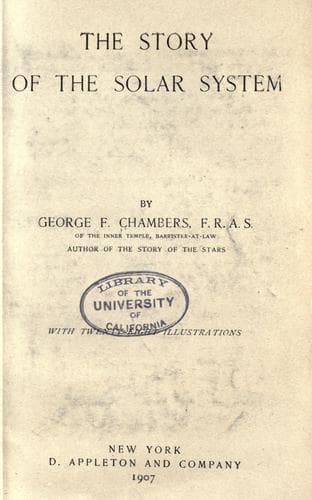
The Story of the Solar SystemChambers, George F. (George Frederick)
Science
The Story of the Solar System
Chambers, George F. (George Frederick)
Solar system
There is another lunar feature to be mentioned somewhat akin to the
foregoing in appearance but apparently, however, owing its origin to a
different cause. I refer to the systems of bright streaks which,
especially at or near the time of full Moon, are seen to radiate from
several of the largest craters, and in particular from Tycho,
Copernicus, Kepler and Aristarchus. These bright streaks extend in many
cases far beyond what may fairly be considered as the neighbourhood of
the craters from which they start, traversing distant mountains, valleys
and other craters in a way which renders it very difficult to assign an
explanation of their origin.
There are 13 areas on the Moon, which used to be regarded as “seas,” one
of them, however, bearing the name of “_Oceanus Procellarum_,” the
“Ocean of Storms”; but besides these there are several bays, termed in
Latin _Sinus_, of which the most important is the _Sinus Iridum_ or the
“Bay of Rainbows,” a beautiful spot on the northern border of the _Mare
Imbrium_, and best seen when the Moon is between 9 and 10 days old. The
summits of the semi-circular range of rocks which enclose the bay are
then strongly illuminated and a greenish shadow marks the valley at its
base. By the way, it is worth mentioning that not a few of the lunar
seas, so-called, seem to be pervaded by a greenish hue, though no
particular explanation of this fact is forthcoming.
Much controversy has ranged round the question whether or not the Moon
has an atmosphere. Without doubt the preponderance of opinion is on the
negative side, though it must be admitted that some observers of
eminence have suggested that there are indeed traces of an atmosphere to
be had, but that it is extremely attenuated and of no great extent,
otherwise it must render its presence discoverable by optical phenomena
which it is certain cannot be detected.
A brief reference may here be made to a curious phenomenon sometimes
seen in connection with occultations of stars by the Moon. Premising
that an “occultation” is the disappearance of a star behind the solid
body of the Moon by reason of the forward movement of the Moon in her
orbit, it must be stated that though generally the Moon extinguishes the
star’s light instantaneously, yet this does not invariably happen, for
sometimes the star seems to hang upon the Moon’s limb as if reluctant to
disappear. No very clear or satisfactory explanation of this phenomenon
has yet been given; the existence of a lunar atmosphere would be an
explanation, and accordingly this anomalous appearance, seen on
occasions, has been advanced in support of the theory that a lunar
atmosphere does exist; but, nevertheless, astronomers do not accept that
idea.
Public-domain text, read in full here on John Shaqi.
Reviews
Reviews
No reviews yet
Be the first to share your thoughts on this work.
Elsewhere in the archive
Join the Discussion
Join the discussion
Sign in to leave a comment or review.
Sign InorCreate an account