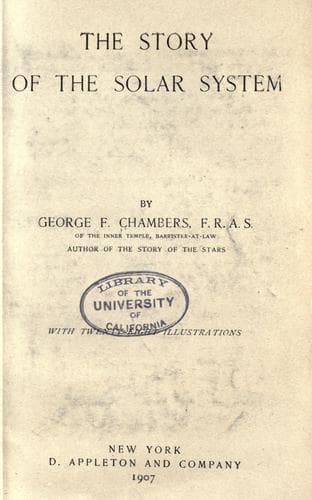
The Story of the Solar SystemChambers, George F. (George Frederick)
Science
The Story of the Solar System
Chambers, George F. (George Frederick)
Solar system
to which the Sun is setting, what he calls the heat-gradient (using a
phrase suggested by terrestrial meteorology) appears to be steeper than
on that part to which the Sun is rising. Generally, Very’s observations
accord fairly with Lord Rosse’s.
The Moon revolves round the Earth in 27 d. 7 h. 43 m. 11 s. at a mean
distance of 237,300 miles, in an orbit which is somewhat, but not very,
eccentric. Its angular diameter at mean distance is 31′ 5″, or, say,
just over ½°. The real diameter may be called 2160 miles.
A few words will probably be expected by the reader on the subject of
lunar influences on the weather, and generally; this being a matter
highly attractive to the popular mind. The truth appears to lie, as
usual, between two extremes of thought. The Moon, of course, is the main
cause of the tides of the Ocean, and it is not entirely inconceivable
that tidal changes imparted to vast masses of water may be either
synchronous with, or may in some way engender, analogous movements in
the Earth’s atmosphere; though no distinct proofs of this, as a
determinate fact, can be brought forward.
There is no doubt whatever that at or near the time of full Moon,
evening clouds tend to disperse as the Moon comes up to the meridian,
and that by the time the Moon has reached the meridian a sky previously
overcast will have become almost or quite clear. Sir John Herschel has
alluded to this by speaking of a “tendency to disappearance of clouds
under a full Moon”; and he considers this “fully entitled to rank as a
meteorological fact.” He goes on, not unnaturally, to suggest the
obvious thought that such dissipation of terrestrial clouds is due to
the circumstance that, assuming heat really comes by radiation from the
Moon (and we have seen on a previous page the probability of this) such
radiant heat will be more potential if it falls on the Earth
perpendicularly, as from a Meridian Moon, than if it comes to us at any
one locality from a Moon low down in the observer’s horizon, and
therefore has to pass through the denser strata of the Earth’s
atmosphere and suffer material enfeeblement accordingly. I am aware that
Mr. Ellis, late of the Royal Observatory, Greenwich, has sought to show
by a seemingly powerful array of statistics that the idea now under
consideration is unfounded, but I consider that we have here only one
more illustration of the familiar statement that you can prove anything
you like by statistics. I am firmly convinced, as the result of more
than 30 years’ observation, that terrestrial clouds do disperse under
the circumstances stated. Sir J. Herschel added that his statement
proceeded from his own observation “made quite independently of any
knowledge of such a tendency having been observed by others. Humboldt,
however, in his _Personal Narrative_, speaks of it as well known to the
pilots and seamen of Spanish America.” Sir John Herschel further
remarked:—“Arago has shown from a comparison of rain, registered as
Public-domain text, read in full here on John Shaqi.
Reviews
Reviews
No reviews yet
Be the first to share your thoughts on this work.
Elsewhere in the archive
Join the Discussion
Join the discussion
Sign in to leave a comment or review.
Sign InorCreate an account