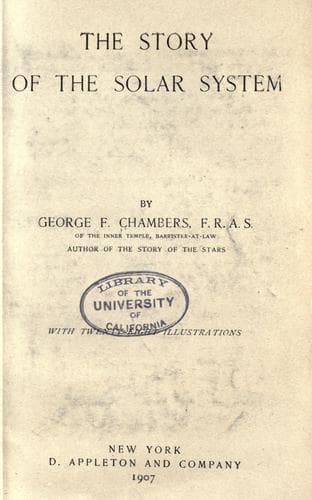
The Story of the Solar SystemChambers, George F. (George Frederick)
Science
The Story of the Solar System
Chambers, George F. (George Frederick)
Solar system
Any one desirous of carrying out a careful study of the Moon’s surface
must be provided with a good map, and for general purposes none is so
convenient or accessible as Webb’s, reduced from Beer and Mädler’s
_Mappa Selenographica_ published in 1837, of which another reproduction
is given in Lardner’s _Astronomy_. Those, however, who would desire to
study the Moon with the utmost attention to detail must provide
themselves with Schmidt’s map published in 1878 at the expense of the
German Government. When it is stated that this map represents the Moon
on a circle 7½ feet in diameter, the size and amount of detail in it
will be readily understood. Special books on the Moon furnishing
numerous engravings and detailed descriptions have been written by
Carpenter and Nasmyth (jointly) and by Neison.
Various attempts have been made to determine the amount of light
reflected by the Moon, and also the question whether it yields any
measurable amount of heat. As regards the light of the full Moon
compared with that of the Sun, the estimates range from 1/300000 to
1/800000, a discrepancy not perhaps greater than might be expected under
the circumstances of the case.
With respect to the heat possessed by, or radiated from the Moon’s
surface, the conclusions of those who have attempted to deal with the
matter are less consistent. As regards the surface of the Moon itself
Sir John Herschel was of opinion that it is heated at least to the
temperature of boiling water, but that owing to the radiant heat having
to pass through our atmosphere, which acts as an obstacle, it is no
wonder that it should be difficult for us to become conscious of its
existence. In 1846 Melloni, by concentrating the rays of the Moon with a
lens 3 feet in diameter, thought he detected a sensible elevation of
temperature; and in 1856 C. P. Smyth at Teneriffe, but with inferior
instrumental appliances, arrived at the same conclusion. Though
Professor Tyndall in 1861 obtained a contrary result, yet the most
recent experiments by the younger Earl of Rosse, Professor Langley, and
others, all tend to show that the Moon does really radiate a certain
infinitesimally small amount of heat. Perhaps, however, it will be best
to give Langley’s ideas as to this in his own words:—“While we have
found abundant evidence of heat from the Moon, every method we have
tried, or that has been tried by others, for determining the character
of this heat appears to us inconclusive; and without questioning that
the Moon radiates heat earthward from its soil, we have not yet found
any experimental means of discriminating with such certainty between
this and reflected heat that it is not open to misinterpretation.” It is
obvious from the foregoing that we on the Earth need not concern
ourselves very much about lunar heat; and I will only add that F. W.
Very, by an ingenious endeavour to localise the Moon’s radiant heat, has
been able, he thinks, to establish the fact that on the part of the Moon
Public-domain text, read in full here on John Shaqi.
Reviews
Reviews
No reviews yet
Be the first to share your thoughts on this work.
Elsewhere in the archive
Join the Discussion
Join the discussion
Sign in to leave a comment or review.
Sign InorCreate an account