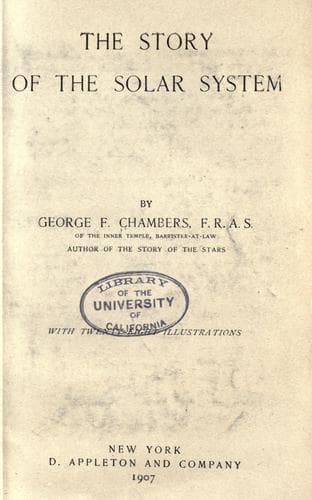
The Story of the Solar SystemChambers, George F. (George Frederick)
Science
The Story of the Solar System
Chambers, George F. (George Frederick)
Solar system
On favourable occasions the brilliancy of Jupiter is very considerable;
so much so that it rivals Venus and Mars. And besides this, there
appears to be something special in the nature of Jupiter’s surface, for
not only does it seem to radiate a much larger proportion of the solar
light which falls on it than do the planets generally, but some
observers have expressed the opinion that it possesses inherent light of
its own. Speculations, however, such as this must always be received
with reserve, because of the evident difficulty of making sure of the
facts on which they must be based. One thing, however, seems less open
to doubt. Bearing in mind the small amount of heat which reaches Jupiter
from the Sun, there is reason to infer that the clouds which certainly
exist on Jupiter must owe their origin to the influence of some other
heat than solar heat; in other words that Jupiter possesses sources of
heat within itself.
Jupiter has satellites, 5 in number. The discovery of four of these, was
one of the first fruits of the invention of the telescope, for they were
found by Galileo in January, 1610. The 5th satellite is so small that it
escaped notice until as recently as 1892, having been discovered on
September 9 of that year by Professor Barnard, with the great Lick
telescope in California. It is, however, so minute that one can count on
one’s fingers the telescopes capable of showing it.
The four old satellites of Jupiter shine as stars of about the 7th
magnitude; in other words, they are sufficiently bright to be visible
with telescopes however small: indeed several instances are on record of
persons gifted with very good sight, having been able to see them with
the naked eye. For the study of their physical appearance very powerful
optical assistance is necessary, but their movements are so rapid, and
the phenomena which result from those movements are so interesting, that
these bodies may be considered to occupy the first place in the
stock-in-trade of every amateur astronomer, who lays himself out for
planet-gazing, with the object of profiting himself or his friends. The
phenomena here alluded to are known as eclipses, transits, and
occultations.
The four old satellites do not bear any names, but are numbered from the
innermost outwards, and are always alluded to by their numbers as I, II,
III and IV.
Public-domain text, read in full here on John Shaqi.
Reviews
Reviews
No reviews yet
Be the first to share your thoughts on this work.
Elsewhere in the archive
Join the Discussion
Join the discussion
Sign in to leave a comment or review.
Sign InorCreate an account