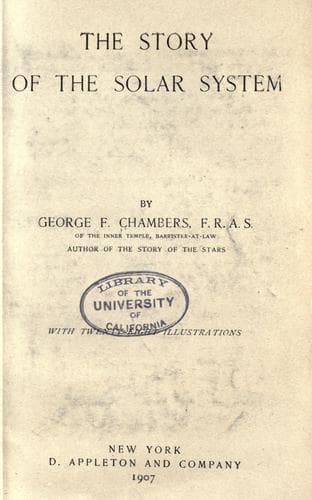
The Story of the Solar SystemChambers, George F. (George Frederick)
Science
The Story of the Solar System
Chambers, George F. (George Frederick)
Solar system
The Dusky Ring is now recognised as a permanent feature of Saturn, but
how far it used to be permanent, or how long it has been so, is a matter
wrapped in doubt. Recorded observations by Picard in 1673, and by Hadley
in 1723, made of course with telescopes infinitely less powerful than
those of the present day, seem to suggest that both the observers named
saw the Dusky Ring, without, however, being able to form a clear
conception that it was a ring. It is strange that during the long period
from 1723 to 1838, no one—not even Sir W. Herschel, with his various
telescopes—should have obtained or at least have recorded any suspicion
of its existence. There is, however, direct evidence that the Dusky Ring
is wider and less faint than formerly. This was directly confirmed by
Carpenter in 1863, who says he saw it “nearly as bright as the
illuminated ring, so much so, that it might easily have been mistaken
for a part of it.” In 1883, Davidson found a marked difference in the
brilliancy of the two ends (_ansæ_) of the ring.
In 1889 Barnard was fortunate enough to observe an eclipse of one of
Saturn’s satellites by the ring, but the eclipse, that is the
concealment of the satellite, was only effected when it passed behind
the bright rings; the dusky ring did not obliterate it, and hence there
was obtained a conclusive proof of the transparency of the dusky ring.
Barnard further concluded from his observations that there was no
separating space or division between the inner bright ring and the dusky
ring, as has frequently been represented in drawings. This transparency
of the Dusky Ring, as a matter of fact, is therefore undoubted; yet what
are we to consider to be the meaning of an observation by Wray in 1861,
that whilst looking at the dusky ring edgeways the impression was
conveyed to his eye that that ring was very much thicker than the bright
rings?
A very interesting question which has been much discussed has reference
to the stability of the rings. It is generally agreed that the
constituent particles of the rings must be in motion round the primary
or their equilibrium could not be maintained: almost equally certain is
it, and for the like reason, that the rings cannot be solid. Of actual
change in the rings as regards their dimensions, we have no satisfactory
proof, though authorities differ on the point, some thinking that the
rings are expanding inwards, so that ultimately they will come into
contact with the ball, whilst others consider no proof whatever of such
change can be obtained from any of the observations yet made in the way
of measurements.
Public-domain text, read in full here on John Shaqi.
Reviews
Reviews
No reviews yet
Be the first to share your thoughts on this work.
Elsewhere in the archive
Join the Discussion
Join the discussion
Sign in to leave a comment or review.
Sign InorCreate an account